Artificial intelligence is changing how businesses attract customers, deliver personalized experiences, and make marketing decisions.
From AI-generated content and intelligent chatbots to predictive analytics and customer personalization, businesses are discovering new opportunities to improve efficiency and customer engagement.
Today, AI in marketing and customer experience is no longer limited to large technology companies. Businesses of different sizes can use AI-powered tools to understand customer needs, automate repetitive tasks, and improve marketing performance.
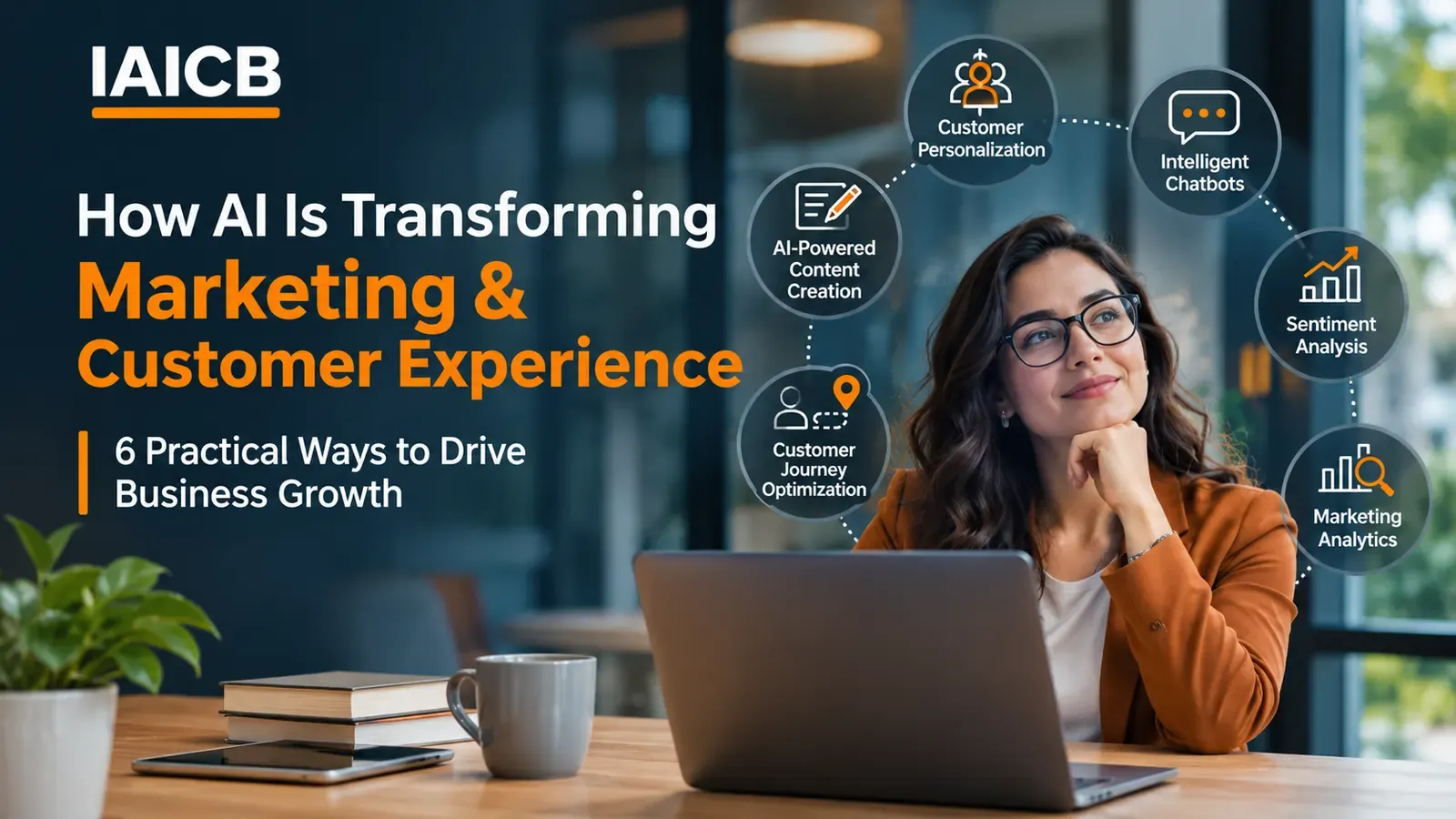
Here are six practical ways artificial intelligence is transforming marketing and supporting business growth.
1. AI-Powered Content Creation: Smarter Marketing Campaigns
Content creation is one of the most widely accessible applications of generative AI in marketing.
AI-powered tools can assist marketing teams in creating:
- Social media posts and advertising copy.
- Email marketing campaigns.
- Product descriptions and website content.
- Blog outlines and promotional materials.
- Personalized marketing messages.
For example, a marketing team can use generative AI to create multiple variations of an email campaign and test which messaging resonates best with customers.
However, human review remains important to maintain accuracy, brand consistency, and originality.
2. AI-Powered Personalization: Deliver Better Customer Experiences
Modern customers often expect businesses to understand their preferences and provide relevant recommendations.
AI-powered personalization helps organizations analyze customer behavior, purchasing patterns, and preferences to create more relevant experiences.
Common applications include:
- Personalized product recommendations.
- Customized website experiences.
- Targeted email marketing.
- Customer segmentation.
- Relevant promotional offers.
For example, an e-commerce platform can recommend products based on a customer's browsing history and previous purchases.
When implemented responsibly, personalization can improve customer engagement, satisfaction, and conversion rates.
3. Intelligent AI Chatbots: Improve Customer Engagement
AI chatbots for customer service are transforming how organizations communicate with customers.
Unlike traditional rule-based chatbots, modern AI-powered assistants can interpret natural-language questions and generate contextually relevant responses.
Businesses can use AI chatbots to:
- Answer frequently asked questions.
- Provide product information.
- Assist customers with order-related queries.
- Support appointment scheduling.
- Route complex requests to human representatives.
For example, an online retailer can deploy an AI assistant to answer questions about delivery policies, product availability, and returns.
Businesses should also provide clear escalation options when an AI assistant cannot resolve a customer's issue.
4. AI Sentiment Analysis: Understand Customer Opinions
Understanding what customers think about a brand is essential for improving products and services.
AI sentiment analysis uses natural language processing (NLP) to analyze customer feedback and identify opinions or emotional signals.
Organizations can apply sentiment analysis to:
- Customer reviews and feedback forms.
- Social media conversations.
- Support tickets and service interactions.
- Online surveys.
- Product satisfaction analysis.
For example, a hospitality business can analyze customer reviews to identify recurring complaints about service quality, cleanliness, or booking experiences.
However, sentiment analysis can misinterpret sarcasm, cultural expressions, and contextual language. Important findings should be reviewed alongside qualitative feedback.
5. AI Customer Journey Optimization: Create Seamless Experiences
The customer journey includes every interaction a person has with a business, from discovering a product to making a purchase and receiving post-purchase support.
AI can help organizations understand these interactions and identify opportunities for improvement.
Businesses can use AI customer journey analytics to:
- Identify where customers abandon purchases.
- Recommend relevant content at different journey stages.
- Predict potential customer churn.
- Improve customer support experiences.
- Identify opportunities for better engagement.
For example, an online business may use AI analytics to identify common checkout difficulties and improve its purchasing process.
6. AI Marketing Analytics: Make Data-Driven Business Decisions
One of the most valuable applications of AI in digital marketing is its ability to analyze large datasets and identify meaningful patterns.
AI marketing analytics helps organizations evaluate campaign performance, understand customer behavior, and improve resource allocation.
Important applications include:
- Predictive Analytics: Forecast customer behavior and demand.
- Campaign Optimization: Identify opportunities to improve marketing performance.
- Customer Segmentation: Group customers based on relevant characteristics.
- Marketing Automation: Reduce repetitive marketing tasks.
- Conversion Analysis: Identify factors affecting customer purchases.
For example, a marketing manager can use AI-powered analytics to identify which campaigns generate valuable leads and adjust future marketing investments.
Organizations should track metrics such as conversion rates, customer acquisition costs, retention, and return on marketing investment.
Responsible AI in Marketing: What Businesses Should Consider
Although AI offers valuable marketing opportunities, organizations must use it responsibly.
Key considerations include customer data privacy, transparency, consent, algorithmic bias, and human oversight.
Businesses should ensure that AI-generated content is accurate, customer information is handled appropriately, and automated marketing decisions follow applicable regulations.
Responsible AI adoption helps organizations build customer trust while supporting long-term business growth.
Frequently Asked Questions
How is AI used in marketing?
AI is used for content creation, customer personalization, marketing automation, chatbots, sentiment analysis, predictive analytics, and campaign optimization.
How does AI improve customer experience?
AI can improve customer experience through personalized recommendations, faster support, relevant communications, and better analysis of customer needs.
Can AI improve marketing ROI?
AI can help businesses improve marketing ROI by optimizing campaigns, reducing repetitive work, and supporting better targeting. Actual returns depend on implementation costs, data quality, and measurable results.
Conclusion: The Future of AI in Marketing
Artificial intelligence is reshaping marketing by helping businesses understand customers, deliver personalized experiences, automate workflows, and make data-driven decisions.
From generative AI and intelligent chatbots to predictive analytics and customer journey optimization, the opportunities are significant.
However, successful AI adoption in marketing requires more than implementing new tools. Businesses must combine AI capabilities with strategic planning, responsible data practices, and human expertise.
Build Practical AI Skills for Modern Business
Want to understand how artificial intelligence can improve marketing, customer engagement, business operations, and decision-making?
Explore the Certified AI Business Professional certification offered by the International AI Certification Board (IAICB).
The program helps business professionals develop knowledge of AI applications, generative AI, business automation, and responsible AI adoption.
Explore the Certified AI Business Professional Program and take the next step toward becoming an AI-ready business professional.
Key takeaways
- Use generative AI to speed content production while keeping human review for brand and accuracy.
- Personalize recommendations, web experiences, and offers with behavior and preference data.
- Deploy AI chatbots for common questions and clear escalation to human support.
- Apply sentiment analysis to reviews and support channels, then validate findings with qualitative feedback.
- Optimize the customer journey and marketing spend with AI analytics, predictive signals, and responsible data practices.