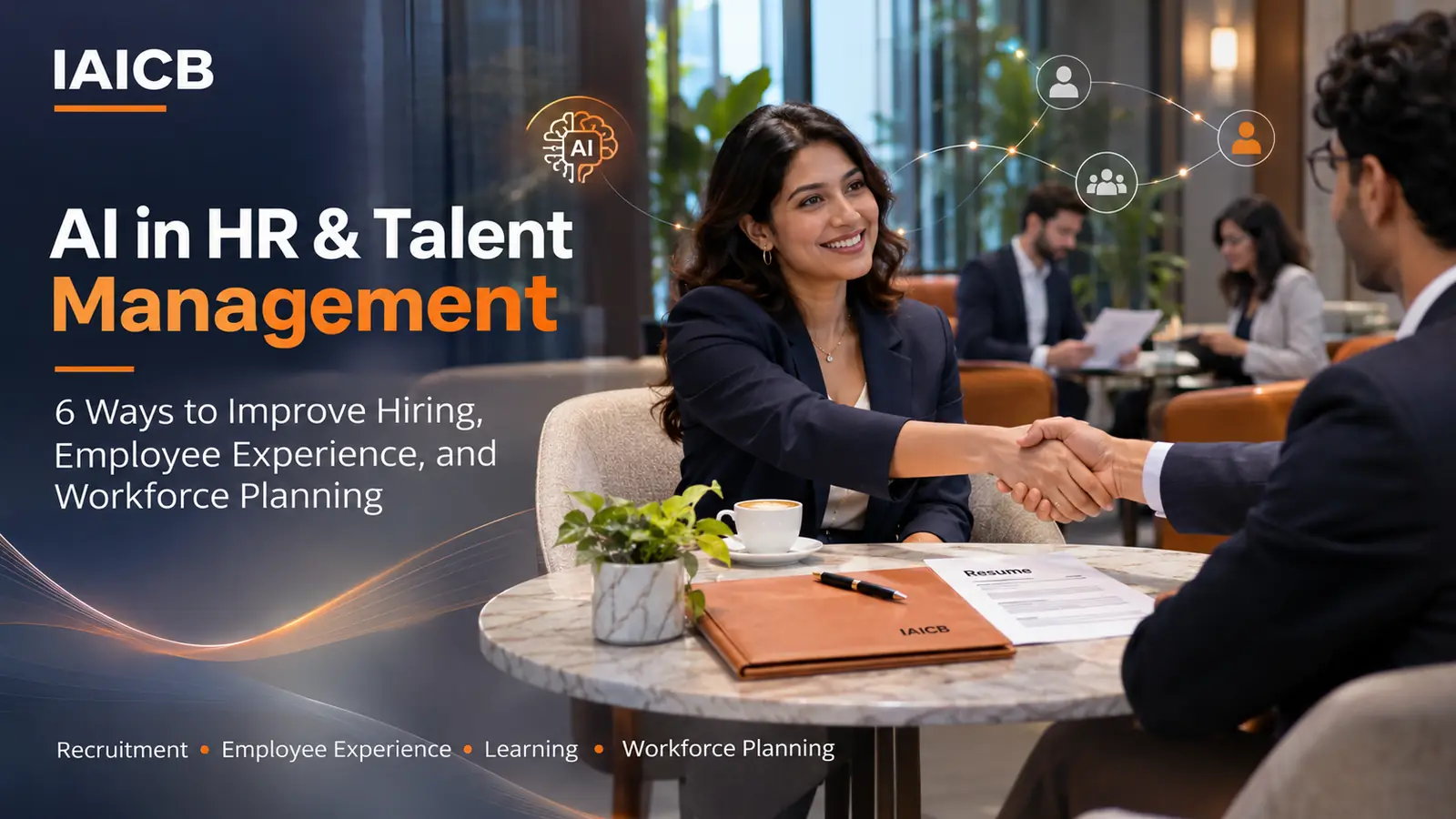
Artificial intelligence is transforming how organizations recruit employees, manage talent, improve workplace experiences, and plan for future workforce needs.
From automated recruitment processes to personalized employee development, AI in HR and talent management is helping businesses streamline operations and make more informed decisions.
However, successful AI adoption in human resources requires more than implementing new technology. Organizations must balance automation with human judgment, employee privacy, and responsible decision-making.
Here are six practical ways artificial intelligence is transforming human resources and helping organizations build more effective HR strategies.
1. AI-Powered Recruitment: Make Hiring More Efficient
Recruitment is one of the most prominent applications of AI in human resources.
Traditional hiring processes often involve reviewing large numbers of applications, scheduling interviews, and identifying suitable candidates.
AI-powered recruitment tools can assist HR teams with:
- Writing job descriptions and recruitment communications.
- Organizing and screening applications against defined criteria.
- Matching candidate skills with job requirements.
- Automating interview scheduling.
- Supporting candidate communication.
For example, a recruitment team can use AI to identify applicants whose documented skills align with a technical job description.
However, AI recommendations should be reviewed by qualified recruiters to reduce the risk of bias and inappropriate hiring decisions.
2. AI Talent Intelligence: Improve Employee Skills and Talent Management
Finding the right talent is only the beginning. Organizations must also understand employee capabilities and identify opportunities for professional growth.
AI talent management platforms can analyze workforce skills, experience, and development requirements.
Important applications include:
- Employee skills mapping.
- Internal talent mobility.
- Skills gap identification.
- Career development recommendations.
- Support for structured talent assessments.
For example, an organization planning to expand its AI capabilities can use talent intelligence tools to identify employees with relevant technical backgrounds who may benefit from additional AI training.
3. AI Employee Experience: Improve Engagement with Intelligent HR Chatbots
Employee experience plays an important role in organizational productivity, satisfaction, and retention.
AI-powered HR chatbots can help employees access information and complete routine administrative tasks.
Common applications include:
- Answering questions about HR policies.
- Supporting employee onboarding.
- Providing information about leave and benefits.
- Assisting with internal HR requests.
- Helping employees find learning resources.
For example, a new employee can use an AI-powered HR assistant to access onboarding materials and answers to common workplace questions.
AI can also help HR teams analyze aggregated employee feedback to identify recurring workplace concerns.
4. AI in Learning and Development: Personalize Workforce Upskilling
As technology changes job responsibilities, organizations must continuously develop employee skills.
AI in learning and development can help HR professionals identify skills gaps and recommend training opportunities.
Organizations can use AI to:
- Assess workforce skill requirements.
- Recommend personalized learning pathways.
- Identify relevant training programs.
- Generate learning materials and practice exercises.
- Monitor employee learning progress.
For example, a marketing professional interested in AI-powered analytics could receive personalized learning recommendations based on their existing skills and career objectives.
AI workforce upskilling helps organizations prepare employees for emerging technologies while supporting professional development.
5. Predictive HR Analytics: Improve Workforce Planning
Effective AI workforce planning requires understanding current staffing requirements and anticipating future workforce needs.
Predictive analytics in HR uses historical workforce data and statistical models to identify patterns that may support planning decisions.
Important applications include:
- Workforce Forecasting: Estimate future staffing requirements.
- Employee Retention Analysis: Identify organizational retention trends.
- Skills Gap Analysis: Support future training investments.
- Performance Analytics: Identify patterns in team performance.
- Talent Supply Planning: Anticipate future recruitment needs.
For example, a growing organization can analyze workforce trends to estimate which departments may require additional employees over the coming year.
However, predictions are not guarantees. HR leaders should validate analytical findings and avoid using potentially biased predictions as the sole basis for individual employment decisions.
6. Generative AI in HR: Automate Administrative Work Responsibly
Generative AI in HR is creating new opportunities to streamline routine administrative and communication tasks.
HR professionals can use generative AI to assist with:
- Drafting recruitment emails and job descriptions.
- Creating onboarding guides and training materials.
- Summarizing HR policies and documents.
- Preparing employee communication templates.
- Developing internal knowledge assistants.
For example, an HR manager can use generative AI to prepare an initial employee onboarding guide, then review and customize it according to organizational policies.
Although these tools can improve efficiency, confidential employee information must be protected, and AI-generated content should be reviewed for accuracy.
Responsible AI in HR: Privacy, Fairness, and Human Oversight
While AI offers valuable opportunities, organizations must consider the ethical implications of using AI in employment-related processes.
Key priorities include:
- Fairness: Evaluate AI systems for potential discrimination and bias.
- Data Privacy: Protect sensitive employee and candidate information.
- Transparency: Communicate relevant information about AI use.
- Human Oversight: Maintain accountability for consequential employment decisions.
- Compliance: Follow applicable employment, privacy, and AI regulations.
Responsible AI adoption in HR helps organizations use technology while protecting employee rights and maintaining trust.
Frequently Asked Questions
How is AI used in human resources?
AI is used in recruitment, employee engagement, talent management, workforce planning, learning and development, HR analytics, and administrative automation.
Can AI improve employee engagement?
AI can support employee engagement through personalized learning, accessible HR support, and analysis of employee feedback. Outcomes depend on how these tools are implemented.
Will AI replace HR professionals?
AI can automate certain HR tasks, but human expertise remains essential for employee relationships, sensitive decisions, organizational culture, and strategic workforce management.
Conclusion: The Future of AI in HR and Talent Management
Artificial intelligence is reshaping human resources by helping organizations improve recruitment processes, develop talent, enhance employee experiences, and make data-driven workforce decisions.
However, the future of AI in HR is not simply about replacing manual processes with automation. It is about combining AI capabilities with human expertise to create more efficient, responsible, and employee-focused HR practices.
Organizations that invest in AI literacy, workforce development, and responsible implementation will be better prepared to adapt to the changing workplace.
Develop Practical AI Skills for HR and Business Management
As AI becomes increasingly integrated into business operations, HR professionals and business leaders need the knowledge to evaluate and implement AI solutions effectively.
Explore the Certified AI Business Professional (CAIBP) certification offered by the International AI Certification Board (IAICB).
Develop your understanding of AI applications in business, HR automation, workforce transformation, generative AI, and responsible AI adoption.
Explore the Certified AI Business Professional Program and strengthen your AI skills for the evolving business environment.
Key takeaways
- Use AI-powered recruitment to screen, match, and schedule candidates — with human review to reduce bias.
- Apply AI talent intelligence for skills mapping, internal mobility, and development recommendations.
- Improve employee experience with HR chatbots for policies, onboarding, leave, and learning support.
- Personalize workforce upskilling with AI learning pathways and progress monitoring.
- Combine predictive HR analytics and generative AI for planning and admin work, under privacy and human oversight.