Artificial intelligence is transforming how businesses manage finances, control risks, and improve operational efficiency. From automated financial reporting to intelligent supply chain management, AI is helping organizations make faster, more informed decisions.
Today, AI in finance and operations is becoming increasingly valuable for CFOs, accountants, operations managers, and business leaders seeking to optimize costs and improve productivity.
By combining machine learning, predictive analytics, and intelligent automation, businesses can streamline processes and identify opportunities for growth.
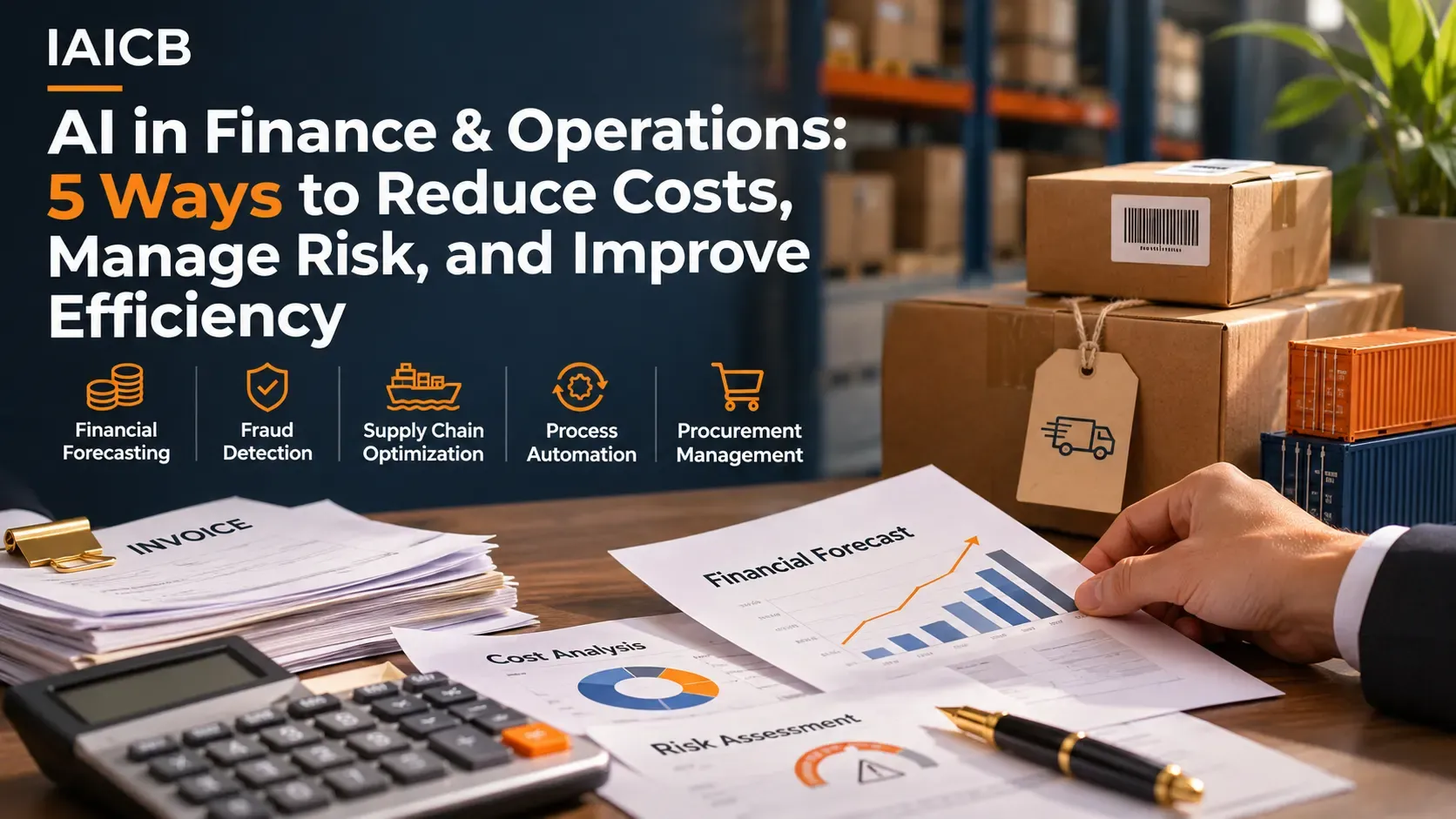
Here are five practical ways AI is transforming finance and business operations.
1. AI in Financial Forecasting and Budgeting
Traditional financial forecasting often relies on historical data, spreadsheets, and manual analysis. AI-powered financial planning tools can analyze large datasets, identify patterns, and generate more dynamic predictions.
Businesses can use AI financial forecasting to:
- Predict revenue and future expenses.
- Improve cash flow forecasting.
- Identify unusual spending patterns.
- Support budget planning and resource allocation.
- Analyze different financial scenarios.
For example, a retail company can use predictive analytics to forecast seasonal sales and adjust its inventory and operating budgets accordingly.
AI-generated forecasts still require human review, particularly when market conditions change unexpectedly.
2. AI Fraud Detection and Financial Risk Management
Financial fraud is a significant concern for businesses, banks, and financial institutions.
AI fraud detection systems use machine learning to analyze transactions, identify unusual behavior, and flag potentially suspicious activities.
Common applications include:
- Detecting unusual financial transactions.
- Identifying potentially fraudulent payment patterns.
- Monitoring account activity.
- Supporting credit risk assessments.
- Improving financial compliance monitoring.
For example, an AI system can flag a transaction that differs significantly from a customer's usual spending behavior.
However, not every unusual transaction is fraudulent. Organizations should combine AI-based alerts with appropriate human investigation and risk controls.
3. AI Supply Chain Optimization and Inventory Management
Managing supply chains involves coordinating suppliers, inventory, logistics, and customer demand.
AI supply chain optimization helps businesses analyze operational data and make better decisions about inventory, transportation, and resource planning.
Organizations can use AI for:
- Demand Forecasting: Predicting future product requirements.
- Inventory Optimization: Identifying potential stock shortages or excess inventory.
- Route Optimization: Improving transportation and delivery planning.
- Supplier Risk Analysis: Detecting potential supply chain disruptions.
- Predictive Maintenance: Identifying equipment issues before breakdowns occur.
For example, a manufacturing company can use AI-powered demand forecasting to plan raw material purchases and improve production scheduling.
4. RPA and AI: Automating Repetitive Business Processes
One of the most practical applications of AI in business operations is intelligent process automation.
Traditional Robotic Process Automation (RPA) follows predefined rules to complete repetitive tasks, while AI can interpret documents, classify information, and support decisions involving less structured data.
Combining RPA and AI enables organizations to automate more complex workflows.
Common applications include:
- Invoice processing and payment workflows.
- Financial data entry and reconciliation.
- Expense report processing.
- Document extraction and classification.
- Automated business reporting.
For example, an accounts payable team can use AI to extract information from invoices and RPA to enter validated details into accounting software.
Human review remains necessary for exceptions, unusual transactions, and sensitive financial approvals.
5. AI in Procurement and Vendor Management
Procurement teams are responsible for managing supplier relationships, purchasing decisions, contracts, and operational spending.
AI in procurement helps organizations analyze supplier data, identify purchasing trends, and improve vendor management.
Businesses can use AI-powered procurement tools to:
- Evaluate supplier performance.
- Analyze procurement spending.
- Identify purchasing inefficiencies.
- Review contract information.
- Monitor supplier risks.
- Support vendor selection decisions.
For example, an organization can use AI analytics to compare suppliers based on delivery reliability, pricing history, and quality performance.
These insights can support procurement professionals in making more informed purchasing decisions.
How Can Businesses Implement AI in Finance and Operations?
Successful AI implementation requires more than adopting new software.
Organizations should follow a practical approach:
- Identify Business Challenges: Select processes where AI could deliver measurable value.
- Evaluate Data Readiness: Ensure financial and operational data is accurate and accessible.
- Start with Pilot Projects: Test AI applications before expanding deployment.
- Establish Governance: Implement security, compliance, and human oversight controls.
- Measure Business Outcomes: Monitor cost savings, processing time, accuracy, and operational performance.
Starting with clearly defined business problems helps organizations evaluate AI investments and scale successful solutions responsibly.
Frequently Asked Questions
How is AI used in finance and accounting?
AI supports financial forecasting, fraud detection, transaction analysis, invoice processing, budgeting, and financial reporting.
What is the difference between RPA and AI?
RPA automates rule-based tasks, while AI can identify patterns, interpret information, and support more complex decisions. Combining both enables intelligent process automation.
Can AI help businesses reduce operational costs?
Yes. AI can help reduce costs by automating repetitive tasks, improving resource allocation, identifying inefficiencies, and supporting more accurate planning. Actual savings depend on implementation and operating costs.
Conclusion: Building Smarter Finance and Business Operations
Artificial intelligence is creating new opportunities for businesses to improve financial management, reduce risks, and optimize operational performance.
From AI-powered financial forecasting and fraud detection to supply chain optimization, intelligent automation, and procurement management, these technologies can support more efficient and data-driven business processes.
However, successful AI adoption requires clear objectives, reliable data, responsible implementation, and human oversight.
Organizations that combine AI capabilities with business expertise will be better positioned to improve productivity and create sustainable value.
Develop Practical AI Skills for Business with IAICB
Understanding how AI transforms financial management and business operations is becoming increasingly important for modern professionals.
Explore the Certified AI Business Professional certification offered by the International AI Certification Board (IAICB).
The program helps business professionals develop knowledge of AI applications, financial automation, operational efficiency, and data-driven decision-making.
Explore the Certified AI Business Professional Program and strengthen your ability to apply artificial intelligence in real-world business environments.
Key takeaways
- Use AI financial forecasting to improve cash flow visibility, budget planning, and scenario analysis.
- Apply AI fraud detection with human review to flag unusual transactions and strengthen risk controls.
- Optimize inventory, logistics, and supplier risk with AI-powered supply chain analytics.
- Combine RPA and AI to automate invoices, reconciliations, and document-heavy workflows.
- Improve procurement and vendor management with spend analytics, supplier scoring, and risk monitoring.