Artificial intelligence is changing how software is developed, businesses operate and digital products are built. As AI adoption expands, professionals with practical AI development skills can explore opportunities across industries.
But if you're starting from scratch, one important question arises: What skills do you need to become an AI developer?
The good news is that you don't need to master advanced AI algorithms immediately. Building a strong foundation in programming, mathematics, development tools and data science is the best place to start.
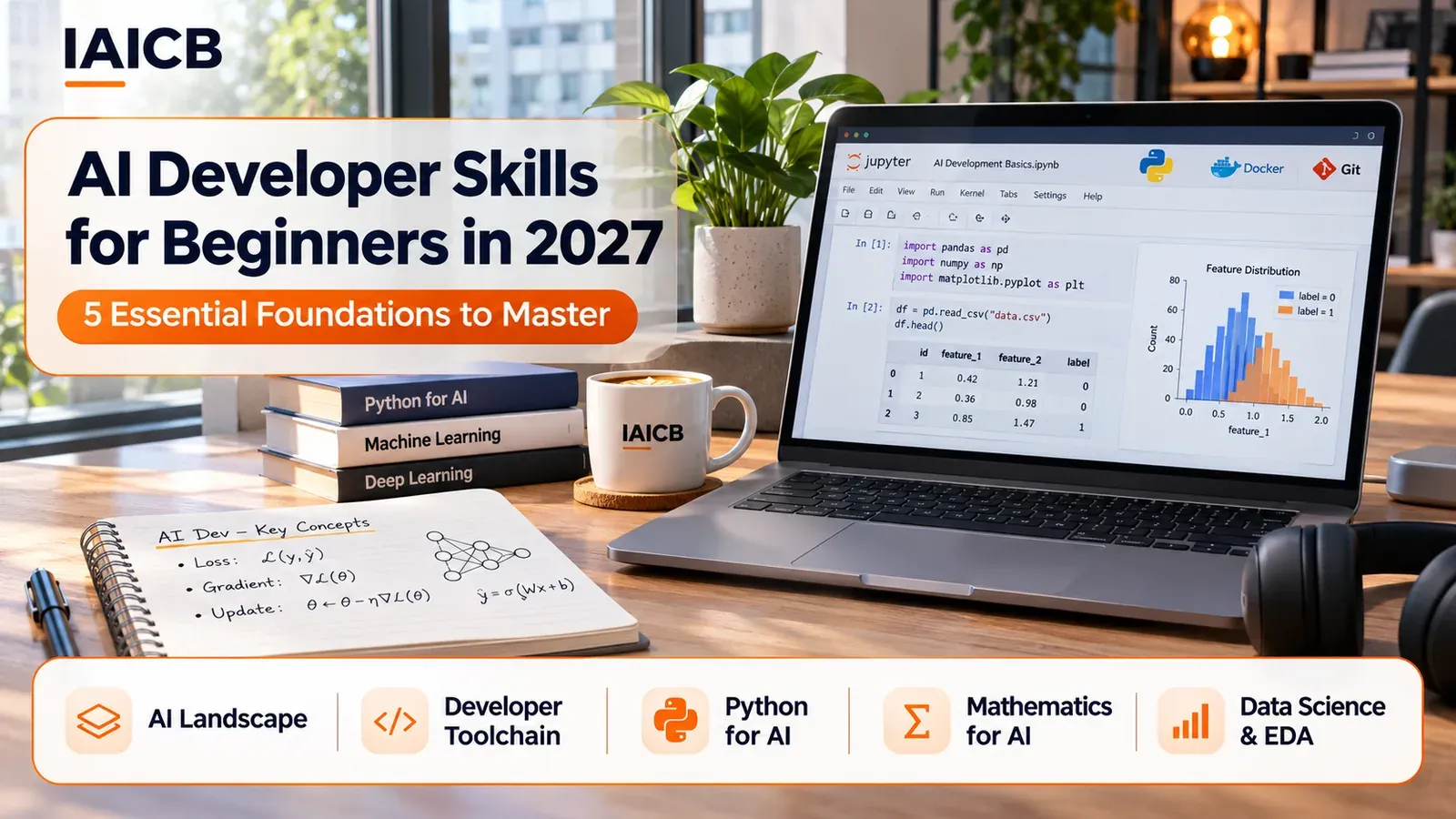
Here are five essential AI developer skills for beginners in 2027 that can help you begin your journey into artificial intelligence.
1. Understand AI, Machine Learning and Deep Learning
Before writing AI applications, it's important to understand how artificial intelligence works.
Three fundamental concepts every aspiring AI developer should know are:
- Artificial Intelligence (AI): Technology that enables machines to perform tasks associated with human intelligence, such as reasoning, language processing and decision-making.
- Machine Learning (ML): A subset of AI that allows systems to learn patterns from data and make predictions.
- Deep Learning: A branch of machine learning that uses multilayer neural networks to process complex information.
Data science is another important field that combines statistics, programming and analytical techniques to extract meaningful insights from data.
For example, recommendation systems use machine learning to suggest products, while generative AI models can produce text, images and code.
Understanding these AI fundamentals helps developers identify which technologies are suitable for different business problems.
2. Learn Essential AI Development Tools
Successful AI developers need more than programming knowledge. They must understand the tools used to build, test and deploy applications.
Some essential AI development tools for beginners include:
- Python — Programming language widely used in AI development.
- VS Code — Writing, debugging and managing code.
- Git & GitHub — Version control and collaboration.
- Jupyter Notebook — Experimenting with code and analyzing data.
- Anaconda — Managing Python environments and packages.
- Docker — Packaging applications for consistent deployment.
For beginners, a practical starting point is installing Python, setting up VS Code and using Jupyter Notebook to experiment with simple datasets.
Learning Git and GitHub early also helps developers manage projects and build a portfolio of their work.
3. Master Python Programming for AI Development
Python for AI development is one of the most valuable skills for aspiring AI developers.
Its readable syntax and extensive ecosystem of libraries make it suitable for machine learning, data science, automation and generative AI applications.
Start with Python fundamentals such as variables, functions, loops, lists and dictionaries.
As your skills improve, explore:
- Object-Oriented Programming (OOP): Organizing code into reusable classes and objects.
- Error Handling: Managing exceptions and improving application reliability.
- Generators: Processing sequences efficiently without loading everything into memory.
- Decorators: Extending or modifying the behavior of functions.
- Asynchronous Programming: Managing concurrent operations, particularly when building applications that interact with APIs.
For example, AI developers use Python to prepare datasets, interact with AI models and create applications powered by machine learning.
Developing strong Python programming skills makes it easier to progress toward advanced AI engineering.
4. Build a Foundation in Mathematics for Machine Learning
You don't need to be a mathematics expert to begin learning AI. However, understanding the mathematical foundations helps you interpret how machine learning algorithms work.
Important topics include:
- Linear Algebra: Vectors, matrices and operations used in neural networks and data representations.
- Probability and Statistics: Understanding uncertainty, distributions, predictions and model performance.
- Differential Calculus: Understanding how mathematical functions change.
- Gradient Descent: An optimization technique used to minimize a model's loss function during training.
For example, when training a machine learning model, gradient descent helps adjust model parameters to reduce prediction errors.
Learning mathematics for machine learning gradually, alongside practical coding exercises, is often more effective than studying every mathematical concept before writing your first AI program.
5. Develop Data Science and Exploratory Data Analysis Skills
AI systems depend heavily on data. Therefore, understanding how to collect, clean, analyze and visualize information is an essential developer skill.
Exploratory Data Analysis (EDA) helps developers understand datasets before using them to train machine learning models.
Four important Python libraries include:
- NumPy: Performing numerical computations and working with arrays.
- Pandas: Cleaning, filtering and analyzing structured datasets.
- Matplotlib: Creating charts and visualizations.
- Seaborn: Building statistical visualizations.
For example, an aspiring AI developer can use Pandas to analyze customer sales data and Matplotlib to visualize monthly revenue trends.
These practical data science fundamentals help developers detect missing values, identify patterns and prepare better-quality training data.
A Simple AI Developer Learning Roadmap
If you're wondering how to start learning AI development, follow this progression:
- Step 1 — AI, machine learning and deep learning fundamentals.
- Step 2 — Python, VS Code, Git and Jupyter Notebook.
- Step 3 — Python programming and software engineering concepts.
- Step 4 — Linear algebra, probability, statistics and calculus.
- Step 5 — Data science, EDA and basic machine learning projects.
Once you understand these foundations, you can progress toward neural networks, generative AI, large language models and AI application development.
Frequently Asked Questions
What skills are required to become an AI developer?
Essential AI developer skills include Python programming, machine learning fundamentals, mathematics, data analysis, software engineering and familiarity with AI development tools.
Is Python enough to start learning AI?
Python is an excellent starting point, but AI developers should also understand mathematics, data science, machine learning concepts and development practices.
Can beginners learn AI without a computer science degree?
Yes. Beginners from different educational backgrounds can learn AI development through structured learning, consistent programming practice and hands-on projects.
Do AI developers need advanced mathematics?
Advanced mathematics is helpful for specialized AI research, but beginners can start with basic linear algebra, probability, statistics and calculus before progressing to more complex topics.
Conclusion: Start Building Your AI Development Skills
Becoming an AI developer begins with mastering the fundamentals rather than jumping directly into advanced AI technologies.
By developing a solid understanding of AI concepts, Python programming, AI development tools, mathematics and data science, beginners can establish the technical foundation needed to build real-world AI applications.
The most effective approach is to combine theoretical knowledge with consistent coding practice and small, practical projects.
Start Your AI Developer Journey with IAICB
Want to move beyond the fundamentals and develop practical AI engineering skills?
Explore the Certified AI Developer (CAID) program offered by the International AI Certification Board (IAICB).
The program provides a structured learning pathway covering essential AI development concepts and more advanced AI technologies.
Build your AI development skills today and prepare for opportunities in the evolving AI industry.
Key takeaways
- Beginners do not need advanced algorithms first — start with AI concepts, tools, Python, maths foundations and data skills.
- Know the difference between AI, machine learning and deep learning so you can match techniques to real problems.
- Learn the developer toolchain early: Python, VS Code, Git, Jupyter, Anaconda and Docker.
- Strong Python skills — including OOP, error handling and async patterns — make later AI engineering much easier.
- Pair basic linear algebra, probability, statistics and gradient descent with practical data science and EDA projects.