Generative artificial intelligence is transforming how developers build intelligent applications. From AI chatbots and virtual assistants to autonomous agents capable of executing complex workflows, the opportunities in generative AI development are expanding rapidly.
However, becoming a generative AI developer requires more than learning how to write prompts. Developers need to understand large language models, retrieval systems, AI agent architecture, and multi-agent orchestration.
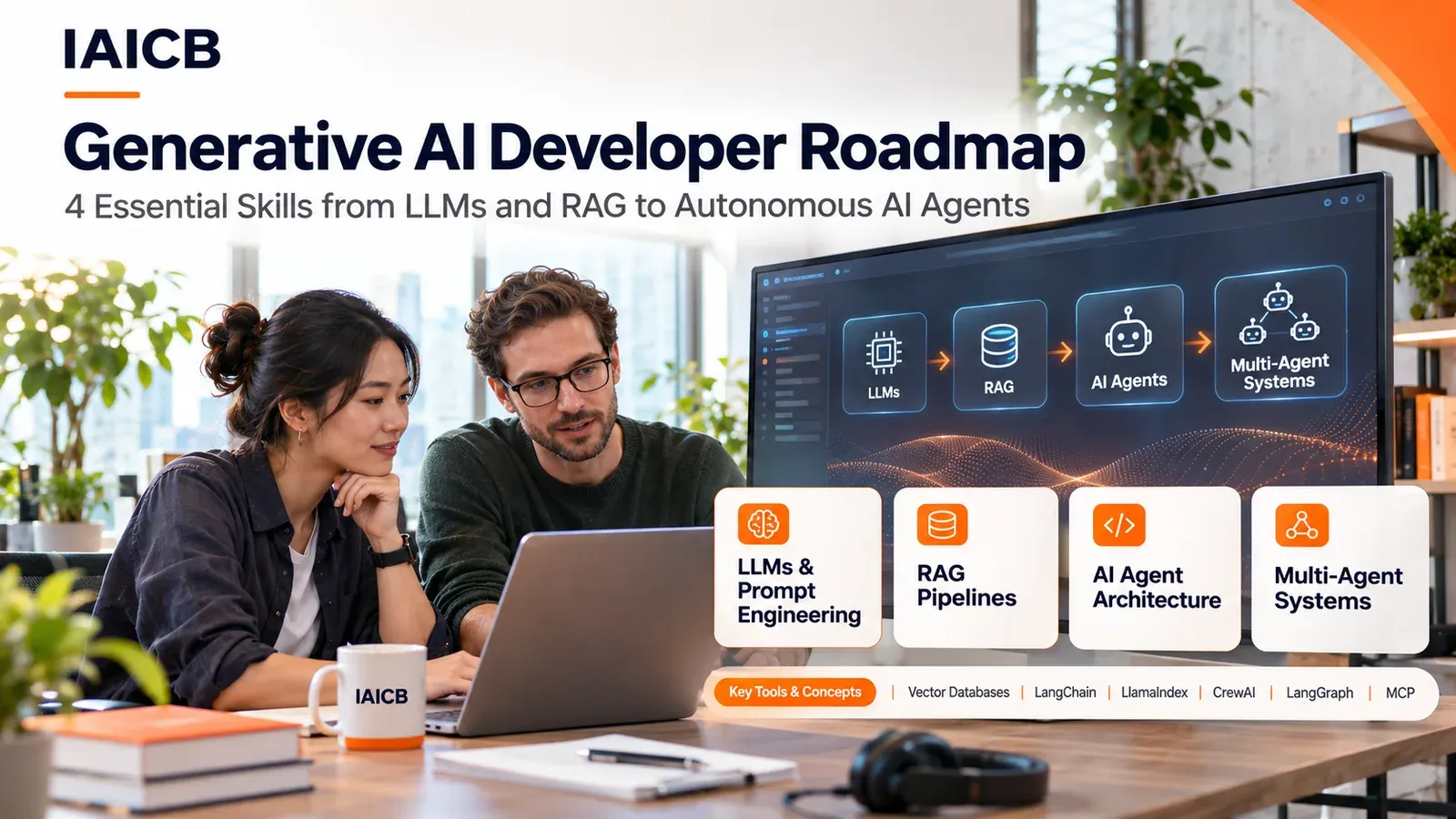
This Generative AI Developer Roadmap outlines four essential skills to help beginners and aspiring AI engineers build practical, intelligent AI applications.
1. Master Generative AI and Large Language Models (LLMs)
The first step in becoming a generative AI developer is understanding how Large Language Models (LLMs) process and generate human language.
LLMs power applications such as ChatGPT, AI coding assistants, document summarization tools, and conversational AI systems.
Essential concepts to learn include:
- Prompt Engineering: Writing effective instructions to guide model responses.
- Context Windows: Understanding how much information an LLM can process within a request.
- Few-Shot Prompting: Providing examples to help models follow specific patterns.
- Reasoning Techniques: Structuring complex tasks into manageable steps.
- LLM APIs: Integrating language models into applications.
- Ollama: Running supported open-weight language models locally.
For example, developers can build an AI-powered text summarization application using an LLM API.
2. Learn Retrieval-Augmented Generation (RAG)
Although LLMs can generate useful responses, they may lack access to current or organization-specific information.
Retrieval-Augmented Generation (RAG) addresses this limitation by retrieving relevant information from external knowledge sources and providing it as context to an LLM.
A typical RAG pipeline includes:
- Document Chunking: Dividing large documents into smaller sections.
- Embeddings: Converting text into numerical representations.
- Vector Databases: Storing and searching embeddings using tools such as FAISS, Chroma, or Pinecone.
- Information Retrieval: Identifying relevant content based on a user's query.
- Response Generation: Using retrieved information to generate an answer.
Developers can use frameworks such as LangChain and LlamaIndex to simplify RAG application development.
For example, a company can develop an AI assistant that answers employee questions using its internal policies, training documents, and knowledge base.
RAG can make responses more relevant and grounded in company information, although retrieval accuracy and output quality still require evaluation.
Learning RAG development and vector databases is valuable for building enterprise AI applications.
3. Understand AI Agent Architecture and Model Context Protocol (MCP)
Traditional AI chatbots primarily respond to user requests. Autonomous AI agents can go further by planning tasks, accessing approved tools, and performing actions within defined boundaries.
An effective AI agent architecture commonly includes:
- Perception: Understanding instructions and available information.
- Planning: Breaking complex objectives into smaller tasks.
- Action: Using authorized tools or APIs to execute tasks.
- Memory: Maintaining relevant information across interactions.
- Evaluation: Checking results and deciding whether additional steps are needed.
Another important technology is the Model Context Protocol (MCP), which standardizes how AI applications connect with external tools and data sources.
For example, an AI research assistant could retrieve information, analyze documents, prepare a summary, and organize findings for human review.
Understanding agentic AI development, tool calling, task decomposition, and MCP helps developers build more capable AI applications.
However, reliable agents also require security controls, monitoring, and human approval for sensitive actions.
4. Build Multi-Agent AI Systems Using CrewAI and LangGraph
As AI applications become more complex, developers can use multi-agent systems to coordinate specialized agents working toward a shared objective.
Instead of assigning every task to one AI agent, multi-agent architectures divide responsibilities across multiple components.
For example, an AI-powered content workflow might involve:
- Research Agent: Collects relevant information.
- Analysis Agent: Organizes findings and identifies key insights.
- Writing Agent: Creates a structured draft.
- Review Agent: Checks content quality and identifies potential errors.
Popular tools for multi-agent AI development include:
- CrewAI — Coordinating specialized AI agents and tasks.
- LangGraph — Building stateful, customizable agent workflows.
- Microsoft Agent Framework — Developing AI agents and orchestrated workflows.
Microsoft Agent Framework also builds on concepts introduced by AutoGen.
Understanding these frameworks helps developers design agent workflows that are easier to monitor, manage, and integrate with business applications.
Not every application needs multiple agents. Developers should choose simpler workflows when they can achieve the same results reliably.
How to Start Your Generative AI Development Journey
Beginners can follow this practical learning sequence:
- Foundation — Python, APIs, and basic machine learning.
- Generative AI — LLMs, prompt engineering, and model integration.
- RAG Development — Embeddings, vector databases, LangChain, and LlamaIndex.
- AI Agents — Tool calling, memory, planning, and MCP.
- Multi-Agent Systems — CrewAI, LangGraph, orchestration, and evaluation.
Start with small applications and gradually introduce more complex capabilities.
Frequently Asked Questions
What skills are required to become a generative AI developer?
Important skills include Python programming, LLM integration, prompt engineering, RAG pipelines, vector databases, AI agent development, and workflow orchestration.
What is the difference between RAG and AI agents?
RAG retrieves external information to support language model responses, while AI agents can plan tasks, use tools, and execute workflows. Agents can also incorporate RAG.
Which frameworks should beginners learn for building AI agents?
LangChain, LangGraph, and CrewAI are useful options. Beginners should start with basic LLM applications before exploring complex agent frameworks.
Conclusion: Build the Skills for Modern AI Development
The future of generative AI development extends beyond creating simple chatbots.
Developers who understand LLMs, RAG pipelines, autonomous AI agents, and multi-agent systems can build applications that retrieve information, interact with tools, and support complex business workflows.
Following a structured learning roadmap helps aspiring developers move from basic generative AI concepts to more advanced AI engineering skills.
Become a Certified AI Developer with IAICB
Want to strengthen your skills in generative AI, RAG, and autonomous AI development?
Explore the Certified AI Developer (CAID) certification offered by the International AI Certification Board (IAICB).
The program covers machine learning, deep learning, generative AI, RAG, AI agent architecture, and multi-agent systems.
Explore the Certified AI Developer Program and develop the knowledge needed to build modern AI applications.
Key takeaways
- Start with LLMs and prompt engineering — context windows, few-shot prompting, APIs, and local tools like Ollama.
- Learn RAG pipelines: chunking, embeddings, vector databases, retrieval, and grounded response generation.
- Understand AI agent architecture — perception, planning, action, memory, evaluation — plus MCP for tool connections.
- Use multi-agent frameworks such as CrewAI and LangGraph when specialized agents improve reliability and oversight.
- Follow a staged path: foundation → generative AI → RAG → agents → multi-agent systems, starting with small apps.