Learning artificial intelligence is one thing. Building an AI application that solves a real-world problem is another.
For aspiring AI developers, machine learning engineers, and computer science students, AI capstone projects provide an opportunity to turn theoretical knowledge into practical development experience.
Whether you're learning generative AI, machine learning, natural language processing (NLP), or autonomous AI agents, building real applications can help you demonstrate your technical abilities to potential employers.
But which AI project should you choose?
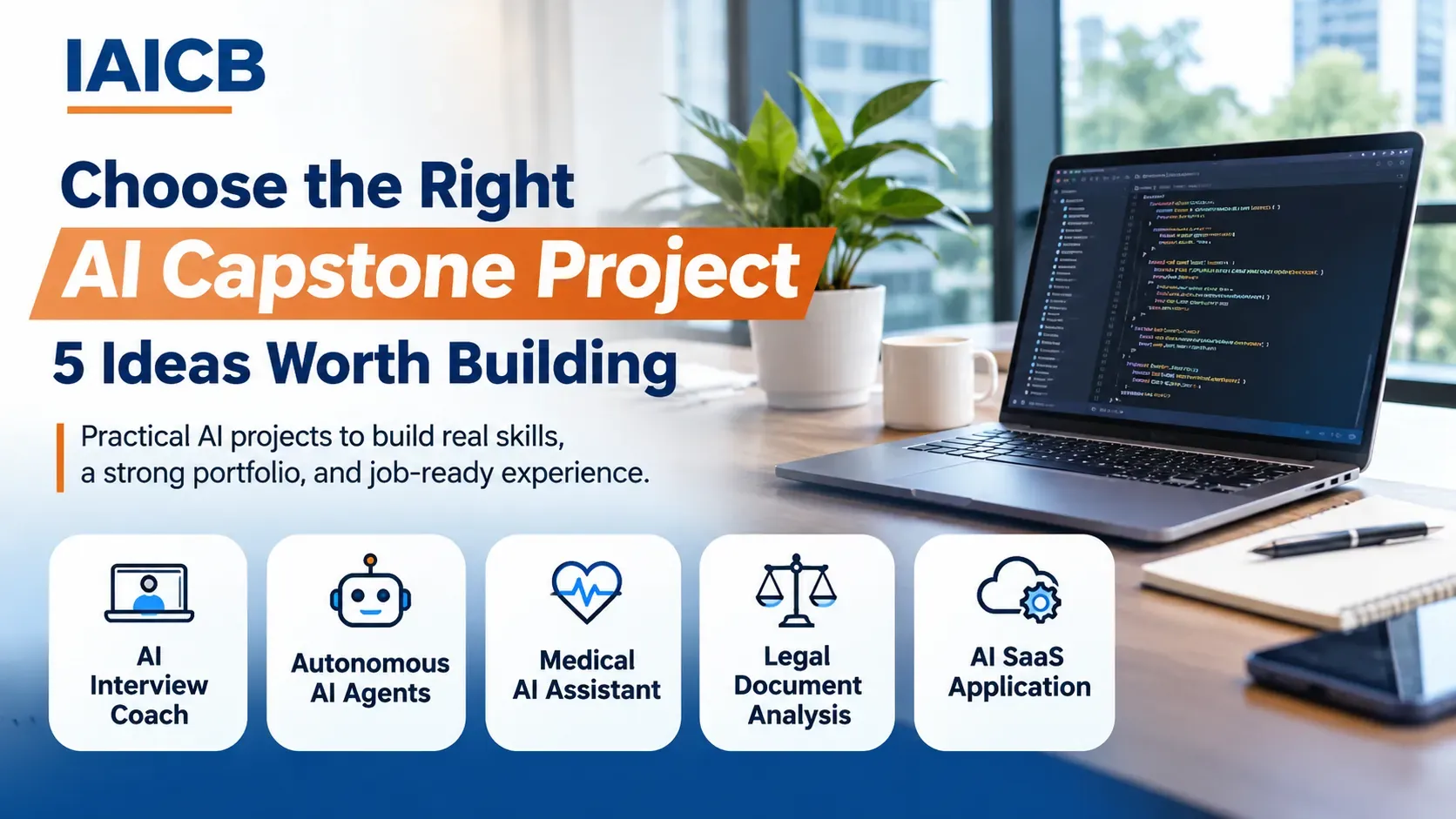
Here are five AI capstone project ideas that can help you develop practical skills and build a stronger AI developer portfolio.
1. AI Interview Coach: Build an Intelligent Career Assistant
An AI Interview Coach is an application that helps job seekers practice interviews, evaluate their responses, and receive personalized feedback.
Using large language models (LLMs) and natural language processing, developers can create an interactive application that simulates interview conversations.
Key features to build:
- AI-generated interview questions based on job roles.
- Automated analysis of candidate responses.
- Personalized suggestions for improving answers.
- Interview performance tracking.
- Conversational interaction using LLM APIs.
Skills demonstrated: Generative AI, NLP, prompt engineering, API integration, and application development.
This is an excellent AI project for beginners and intermediate developers because it combines practical business value with accessible AI technologies.
2. Autonomous AI Research Agent: Build an Agentic AI Application
Autonomous AI agents are becoming an important area of AI development because they can coordinate tasks, use tools, and execute workflows within defined boundaries.
An AI Research Agent can help users collect information, analyze documents, summarize findings, and prepare structured research reports.
Developers can build this application using frameworks such as LangGraph or CrewAI.
Key features to build:
- Automated information retrieval.
- Task planning and decomposition.
- Integration with approved search tools and APIs.
- Document summarization and analysis.
- Source verification and report generation.
Skills demonstrated: Agentic AI, tool calling, LLM integration, workflow orchestration, and AI agent architecture.
This project is particularly useful for developers interested in building AI agents and multi-agent systems.
3. Medical AI Assistant: Build a Healthcare Knowledge Application
Healthcare presents valuable opportunities for AI-powered information retrieval and document analysis.
A Medical AI Assistant project can help users search educational medical resources, summarize research papers, or retrieve relevant information from trusted healthcare documents.
One suitable approach is using Retrieval-Augmented Generation (RAG) to connect an LLM with a curated medical knowledge base.
Key features to build:
- Medical document search and retrieval.
- Research paper summarization.
- RAG-based question answering.
- Source citations and document references.
- Response evaluation and safety checks.
Skills demonstrated: RAG pipelines, vector databases, LLMs, document processing, and responsible AI development.
4. AI Legal Document Analyzer: Build an NLP-Powered Application
Legal professionals often work with lengthy contracts, agreements, and regulatory documents.
An AI Legal Document Analyzer can help users identify relevant clauses, summarize documents, and locate important information more efficiently.
Developers can combine NLP, document processing, and RAG to build this application.
Key features to build:
- PDF and document text extraction.
- Automated document summarization.
- Clause identification and categorization.
- Contract comparison.
- Natural-language document search.
Skills demonstrated: NLP, document intelligence, RAG, text classification, and AI application engineering.
This project demonstrates how AI can support document-heavy business workflows. Use publicly available or synthetic legal documents and make clear that the tool does not replace professional legal review.
5. AI SaaS Application: Build a Production-Ready AI Product
For developers looking for a more advanced challenge, building an AI Software-as-a-Service (SaaS) application can demonstrate end-to-end engineering skills.
An AI SaaS product could provide automated content analysis, customer support assistance, business analytics, or document intelligence.
Unlike a basic AI prototype, a SaaS application requires developers to consider scalability, security, user experience, and deployment.
Key features to build:
- User authentication and account management.
- Integration with AI models through APIs.
- Database and backend development.
- Cloud deployment and monitoring.
- Usage tracking and subscription-ready architecture.
Skills demonstrated: Full-stack AI development, cloud computing, API engineering, MLOps, and scalable AI architecture.
This is a valuable advanced AI portfolio project because it demonstrates the ability to build and maintain an integrated AI application.
Which AI Capstone Project Should You Choose?
The best project depends on your technical experience and career goals.
- AI Interview Coach — Beginner–Intermediate. Main focus: LLMs and NLP.
- Autonomous AI Research Agent — Intermediate–Advanced. Main focus: Agentic AI.
- Medical AI Assistant — Intermediate–Advanced. Main focus: RAG and responsible AI.
- Legal Document Analyzer — Intermediate. Main focus: NLP and document intelligence.
- AI SaaS Application — Advanced. Main focus: Full-stack AI and deployment.
Rather than building several incomplete applications, focus on developing one well-documented project with measurable results.
How to Showcase Your AI Projects on GitHub
Building an application is only part of developing a professional AI engineer portfolio.
Your GitHub repository should demonstrate how you approach real engineering problems.
Include:
- A clear README explaining the project and its purpose.
- System architecture and technologies used.
- Setup instructions and API documentation.
- Screenshots or a working demonstration.
- Model evaluation results and testing methods.
- Known limitations, security considerations, and future improvements.
A complete end-to-end AI project can provide stronger evidence of practical skills than a repository containing only a basic model or notebook.
Frequently Asked Questions
What are the best AI capstone projects for beginners?
AI interview coaches, sentiment analysis applications, document summarizers, and basic AI chatbots are useful starting points for beginners.
Are AI capstone projects useful for getting an AI developer job?
Well-executed projects can help demonstrate practical programming, AI engineering, problem-solving, and deployment skills. They complement education and certifications but do not guarantee employment.
What makes an AI project production-ready?
Production readiness generally requires testing, security controls, reliable deployment, performance monitoring, documentation, and appropriate scalability.
Conclusion: Turn AI Knowledge into Practical Experience
The best AI capstone projects are those that demonstrate both technical knowledge and real-world problem-solving.
Whether you build an AI Interview Coach, an Autonomous AI Agent, a Medical AI Assistant, a Legal Document Analyzer, or an AI SaaS platform, focus on developing an application that is functional, well-tested, and properly documented.
Building practical AI projects can help aspiring developers strengthen their portfolios and prepare for more advanced AI engineering responsibilities.
Advance Your AI Development Skills with IAICB
Want to build your technical knowledge in machine learning, generative AI, RAG, autonomous agents, and production-ready AI development?
Explore the Certified AI Developer (CAID) certification offered by the International AI Certification Board (IAICB).
The program covers essential technologies and engineering concepts needed to design, develop, and deploy modern AI applications.
Explore the Certified AI Developer Program and take the next step in your AI development journey.
Key takeaways
- Pick one AI capstone project and finish it well — a documented, working app beats several incomplete demos.
- An AI Interview Coach is a strong beginner–intermediate project that showcases LLMs, NLP, and prompt engineering.
- Autonomous research agents highlight agentic AI, tool calling, and workflow orchestration with frameworks like LangGraph or CrewAI.
- Medical and legal assistants demonstrate RAG, document intelligence, and responsible AI — use public or synthetic data and clear disclaimers.
- An AI SaaS product signals advanced, production-minded skills: auth, APIs, cloud deployment, monitoring, and scalable architecture.