Artificial intelligence (AI) is transforming how we work, communicate, and make business decisions. From ChatGPT and virtual assistants to automated customer service and predictive analytics, AI is becoming an essential part of modern business operations.
But what is artificial intelligence, how did it begin, and why is it so important for business professionals?
Understanding the fundamentals of AI is the first step toward using this technology effectively in the workplace.
What Is Artificial Intelligence?
Artificial Intelligence (AI) refers to computer systems designed to perform tasks that typically require human intelligence, such as understanding language, recognizing patterns, making predictions, and solving problems.
Unlike traditional software that primarily follows explicitly programmed instructions, many modern AI systems can learn patterns from data and use those patterns to generate predictions, recommendations, or responses.
For example:
- Traditional Software: A customer support system routes queries using predefined rules.
- Artificial Intelligence: An AI-powered assistant interprets customer questions and generates relevant responses.
AI does not necessarily think or understand information like humans. Instead, it uses algorithms, data, and mathematical models to perform intelligent tasks.
A Brief History of Artificial Intelligence
Although AI feels like a recent technological breakthrough, its foundations were established decades ago.
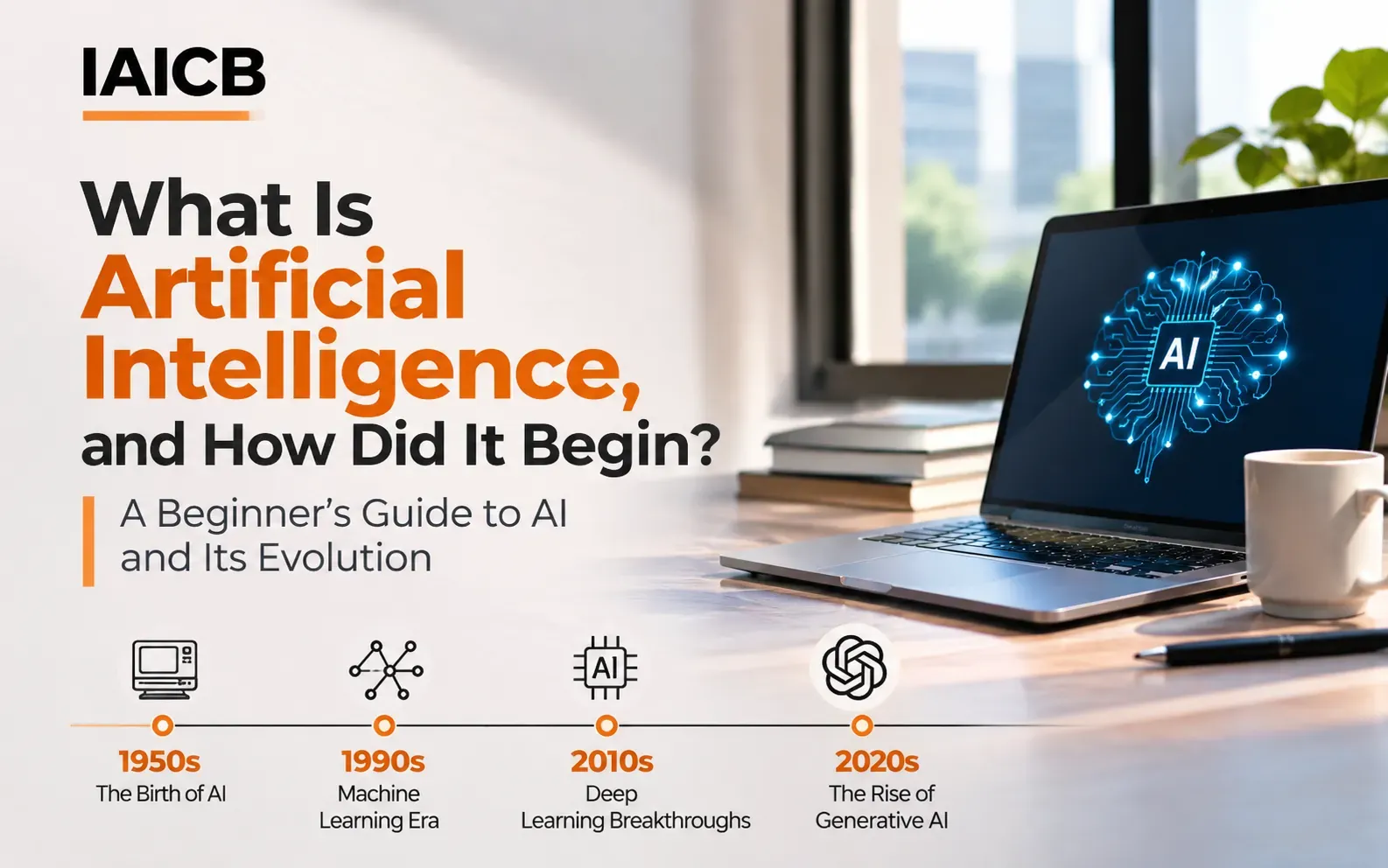
1950s: The Birth of Artificial Intelligence
In 1950, mathematician Alan Turing published influential work exploring whether machines could demonstrate intelligent behavior.
The term Artificial Intelligence became established through the Dartmouth research project in 1956, widely considered a foundational event in AI research.
1960s–1980s: Early AI and Expert Systems
Researchers developed programs capable of solving mathematical problems, processing simple language, and applying predefined knowledge to specific tasks.
Expert systems became an important application of AI, helping organizations support decisions in specialized fields.
1990s–2000s: The Rise of Machine Learning
AI increasingly shifted toward machine learning, allowing systems to identify patterns from data rather than relying entirely on manually written rules.
This development helped expand applications such as fraud detection, search engines, and recommendation systems.
2010s: Deep Learning Breakthroughs
Advancements in computing power, large datasets, and neural networks accelerated deep learning.
AI systems achieved major improvements in image recognition, speech processing, and natural language understanding.
2020s: Generative AI and Intelligent Automation
The emergence of powerful large language models (LLMs) and generative AI applications brought artificial intelligence into everyday professional workflows.
Tools such as ChatGPT demonstrated how AI could assist with writing, research, coding, analysis, and communication.
Today, organizations are also exploring AI agents capable of coordinating multistep business tasks.
How Is AI Different from Traditional Software?
- Instructions: Traditional software primarily follows predefined instructions; AI can learn patterns from data.
- Behavior: Traditional software usually relies on explicitly defined rules; AI can generate predictions and recommendations.
- Updates: Traditional software often requires manual updates to change behavior; some AI models can improve through retraining.
- Best fit: Traditional software suits predictable workflows; AI is useful for complex, data-driven tasks.
Both technologies are valuable, and modern business applications often combine traditional software with AI capabilities.
Why Artificial Intelligence Matters for Business Professionals
AI is no longer relevant only to software developers and data scientists.
Business professionals across industries are using AI to improve productivity, analyze information, and support strategic decisions.
Some common AI applications in business include:
- Marketing: Customer segmentation, campaign analysis, and content development.
- Human Resources: Recruitment administration and workforce analytics.
- Finance: Fraud detection, financial forecasting, and reporting.
- Customer Service: AI chatbots and automated support workflows.
- Operations: Demand forecasting, process optimization, and intelligent automation.
However, successful AI adoption requires understanding its capabilities, limitations, data privacy risks, and the importance of human oversight.
For business leaders, AI literacy is becoming an increasingly valuable professional skill.
Frequently Asked Questions
What is artificial intelligence in simple words?
Artificial intelligence is technology that enables computers to perform tasks associated with human intelligence, such as recognizing patterns, understanding language, and making predictions.
Who invented artificial intelligence?
AI emerged through contributions from multiple researchers. John McCarthy helped establish the field and coined the term Artificial Intelligence, while Alan Turing made foundational contributions to its theoretical development.
Do business professionals need coding skills to learn AI?
Not necessarily. Business professionals can begin by understanding AI concepts, business applications, prompt engineering, responsible AI, and AI-driven decision-making without advanced programming knowledge.
Conclusion: Understanding AI Is the First Step Toward Using It
Artificial intelligence has evolved from early academic research into a powerful technology influencing nearly every industry.
Understanding what artificial intelligence is, how it developed, and how it works provides a strong foundation for making informed business decisions.
As AI continues to evolve, professionals who understand its business applications will be better prepared to identify opportunities, manage risks, and participate in AI-driven transformation.
Build Your AI Business Skills with IAICB
Want to understand how artificial intelligence can improve business productivity, decision-making, and organizational performance?
Explore the Certified AI Business Professional program offered by the International AI Certification Board (IAICB).
Develop practical knowledge of AI fundamentals, generative AI, business automation, and responsible AI adoption—without needing an advanced technical background.
Explore the Certified AI Business Professional Certification and take the next step toward becoming an AI-ready business professional.
Key takeaways
- AI systems perform tasks associated with human intelligence—language, patterns, predictions, and problem-solving—using data and algorithms rather than human-like understanding.
- AI research spans decades: from Turing and Dartmouth in the 1950s, through expert systems and machine learning, to deep learning and generative AI.
- Traditional software follows predefined rules; many modern AI systems learn patterns from data and can improve through retraining.
- Business professionals use AI across marketing, HR, finance, customer service, and operations—alongside human oversight and risk awareness.
- AI literacy helps leaders identify opportunities, manage limitations, and participate in AI-driven transformation without needing advanced coding skills.