Building an artificial intelligence model is only the beginning. The real challenge begins when developers need to deploy, monitor, and scale AI applications in production environments.
As businesses increasingly integrate AI into everyday operations, skills in MLOps, computer vision, cloud deployment, and AI system design are becoming essential for AI developers and machine learning engineers.
A structured MLOps roadmap helps developers move beyond experimentation and build reliable, scalable, production-ready AI systems.
Here are four essential skills every aspiring AI developer should learn.
1. Master Computer Vision with OpenCV and YOLO
Computer vision enables AI systems to interpret and analyze images and videos. It powers applications such as facial recognition, medical imaging, autonomous vehicles, and industrial quality inspection.
Developers should focus on learning:
- OpenCV: Image processing, filtering, and computer vision applications using Python.
- YOLO (You Only Look Once): Real-time object detection.
- Image Segmentation: Identifying and separating objects or regions within images.
- Optical Character Recognition (OCR): Extracting text from images and scanned documents.
For example, a manufacturing company can use YOLO object detection to identify defective products on an assembly line.
Learning computer vision with Python provides a strong foundation for developing AI applications that process visual information.
2. Understand the MLOps Lifecycle and Model Deployment
Training a machine learning model is different from operating it reliably in a real-world application.
Machine Learning Operations (MLOps) combines machine learning development with operational practices to automate model deployment, monitoring, and maintenance.
Important MLOps tools and technologies include:
- MLflow — Experiment tracking and model lifecycle management.
- FastAPI — Building APIs to serve AI model predictions.
- Docker — Packaging AI applications into containers.
- Kubernetes — Managing and scaling containerized applications.
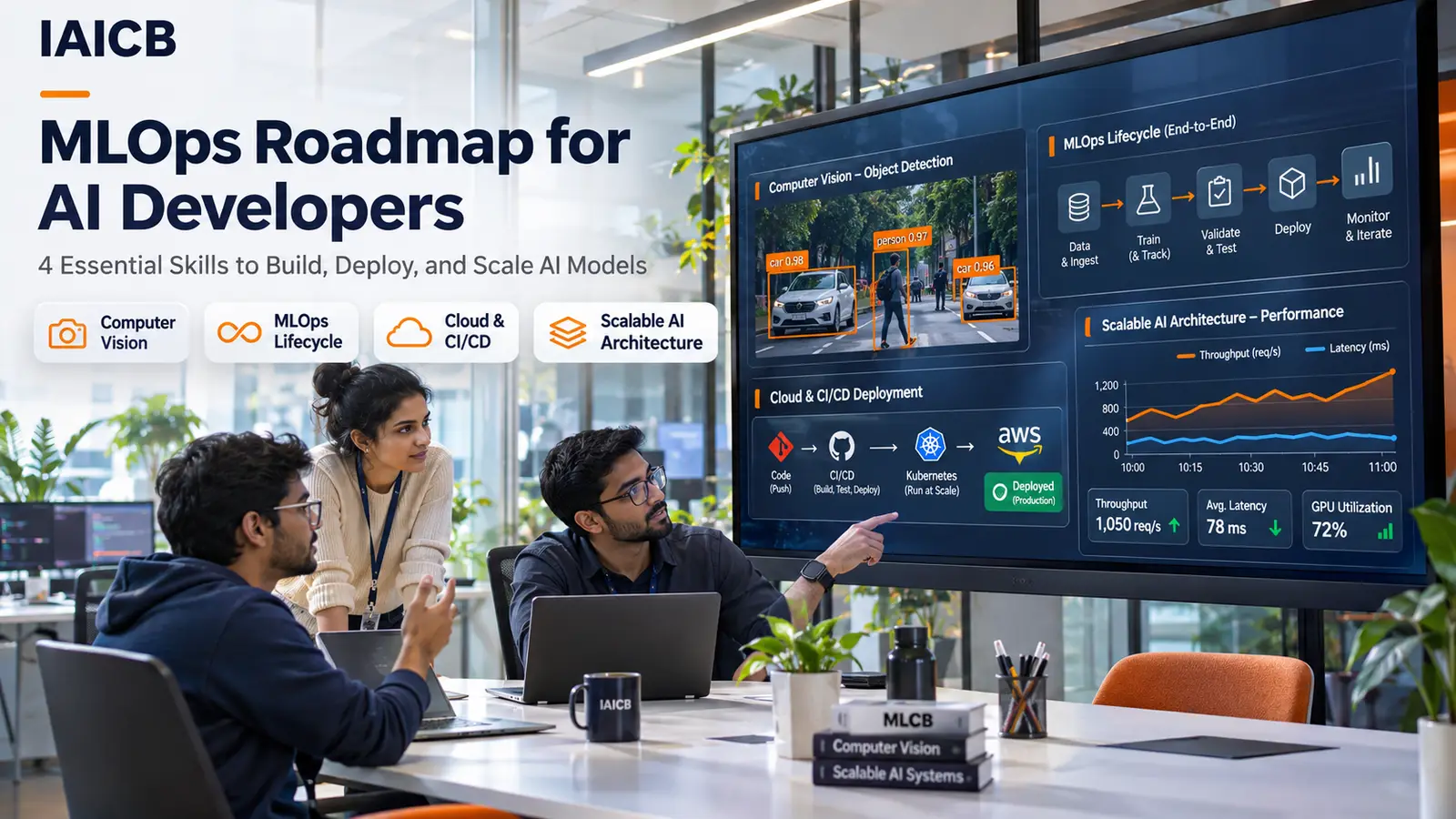
A typical MLOps pipeline includes data preparation, model training, evaluation, deployment, monitoring, and retraining when necessary.
For example, an AI developer can track model experiments with MLflow, build a prediction API using FastAPI, and package the application with Docker.
Understanding these technologies helps developers create reliable AI applications that can operate beyond local development environments.
3. Deploy AI Models to the Cloud Using CI/CD
Modern AI applications often require cloud infrastructure to support growing workloads, storage requirements, and computing demands.
Developers should understand how to deploy machine learning models using platforms such as:
- AWS: Amazon SageMaker AI and other cloud services for model development and deployment.
- Microsoft Azure: Azure Machine Learning for managing AI development workflows.
- Google Cloud: Vertex AI for developing, deploying, and managing machine learning models.
Another essential skill is CI/CD for machine learning.
Continuous Integration and Continuous Delivery help automate testing, packaging, and deployment processes.
For example, when an AI developer updates a model-serving application, an automated CI/CD pipeline can run tests, build a container, and deploy the updated application after the necessary checks.
Cloud MLOps and automated deployment pipelines help organizations improve deployment consistency, reduce manual errors, and manage AI applications at scale.
4. Design Scalable AI Systems with Low-Latency Inference
As AI applications attract more users, developers must ensure their systems remain fast, reliable, and cost-efficient.
Scalable AI architecture focuses on building systems that can handle increasing workloads without significant performance degradation.
Essential concepts include:
- GPU Optimization: Improving computational efficiency for model training and inference.
- Model Inference Optimization: Reducing response times through techniques such as quantization and batching.
- Caching: Reusing appropriate results to reduce unnecessary processing.
- Vector Search at Scale: Efficiently retrieving relevant information from large embedding collections.
- Streaming: Delivering generated responses progressively where supported.
- Load Balancing: Distributing requests across available computing resources.
For example, a generative AI chatbot serving thousands of users may require optimized inference, caching, request management, and scalable infrastructure.
Understanding AI system design and low-latency inference helps developers build applications that perform reliably under real-world workloads.
Practical Example: Deploying an AI-Powered Object Detection System
Consider an AI developer building a computer vision application to detect defective products.
A practical development workflow could involve:
- Model Development: Train and evaluate an object detection model using YOLO.
- Experiment Tracking: Record model performance and experiments using MLflow.
- API Development: Create a prediction API using FastAPI.
- Cloud Deployment: Containerize the application with Docker and deploy it to cloud infrastructure.
- Monitoring: Track prediction accuracy, response latency, system reliability, and operating costs.
This example demonstrates how computer vision, MLOps, cloud infrastructure, and scalable system design work together to create a production-ready AI application.
Frequently Asked Questions
What is MLOps in artificial intelligence?
MLOps is a set of practices and tools used to manage the machine learning lifecycle, including model development, deployment, monitoring, and maintenance.
What skills are required to become an MLOps engineer?
Important skills include Python, machine learning, Docker, Kubernetes, MLflow, cloud platforms, CI/CD pipelines, and model monitoring.
What is the difference between MLOps and DevOps?
DevOps primarily focuses on software development and operations, while MLOps extends these practices to address machine learning challenges such as data changes, model evaluation, retraining, and performance monitoring.
Conclusion: Move from AI Models to Production-Ready Systems
Becoming a successful AI developer requires more than understanding machine learning algorithms.
Developers must also learn how to deploy models, automate workflows, manage cloud infrastructure, and optimize AI applications for real-world performance.
By mastering computer vision, MLOps pipelines, cloud deployment, and scalable AI architecture, aspiring developers can build the technical foundation needed to create reliable AI systems.
Build Your AI Development Skills with IAICB
Want to advance your skills in machine learning, MLOps, computer vision, and enterprise AI development?
Explore the Certified AI Developer (CAID) certification offered by the International AI Certification Board (IAICB).
The program covers machine learning, deep learning, generative AI, computer vision, MLOps, and scalable AI system design.
Explore the Certified AI Developer Program and develop the knowledge needed to build, deploy, and scale modern AI applications.
Key takeaways
- Build computer vision foundations with OpenCV, YOLO, segmentation, and OCR before production work.
- Learn the MLOps lifecycle — experiment tracking, APIs, containers, and orchestration with MLflow, FastAPI, Docker, and Kubernetes.
- Deploy models on AWS, Azure, or Google Cloud and automate releases with CI/CD for machine learning.
- Design for scale with GPU optimization, quantization, caching, vector search, streaming, and load balancing.
- Connect the skills in one workflow: train, track, serve, deploy, and monitor a production object-detection system.