Your company may already have an AI strategy. But can you identify one business process AI will improve, who is responsible, and how success will be measured?
That is the difference between experimenting with AI and implementing it successfully.
According to McKinsey's 2026 State of AI report, 44% of survey respondents said their organizations were scaling AI across the enterprise, up from 38% in 2025.
The challenge for business leaders is turning AI investment into measurable results.
This practical 90-day AI implementation plan explains how to get started.
What You'll Learn
- How to identify high-value opportunities for AI implementation.
- How to create and execute a realistic 90-day AI roadmap.
- How to measure business impact and decide whether to scale.
Why AI Implementation Often Stalls
Organizations may invest in advanced AI tools without changing the workflows those tools are intended to improve.
The result? Disconnected projects, unclear financial returns, poor employee adoption, and operational challenges.
A successful AI business implementation strategy must connect technology with three priorities: business value, organizational readiness, and measurable performance.
Rather than automating everything, start by improving one clearly defined process.
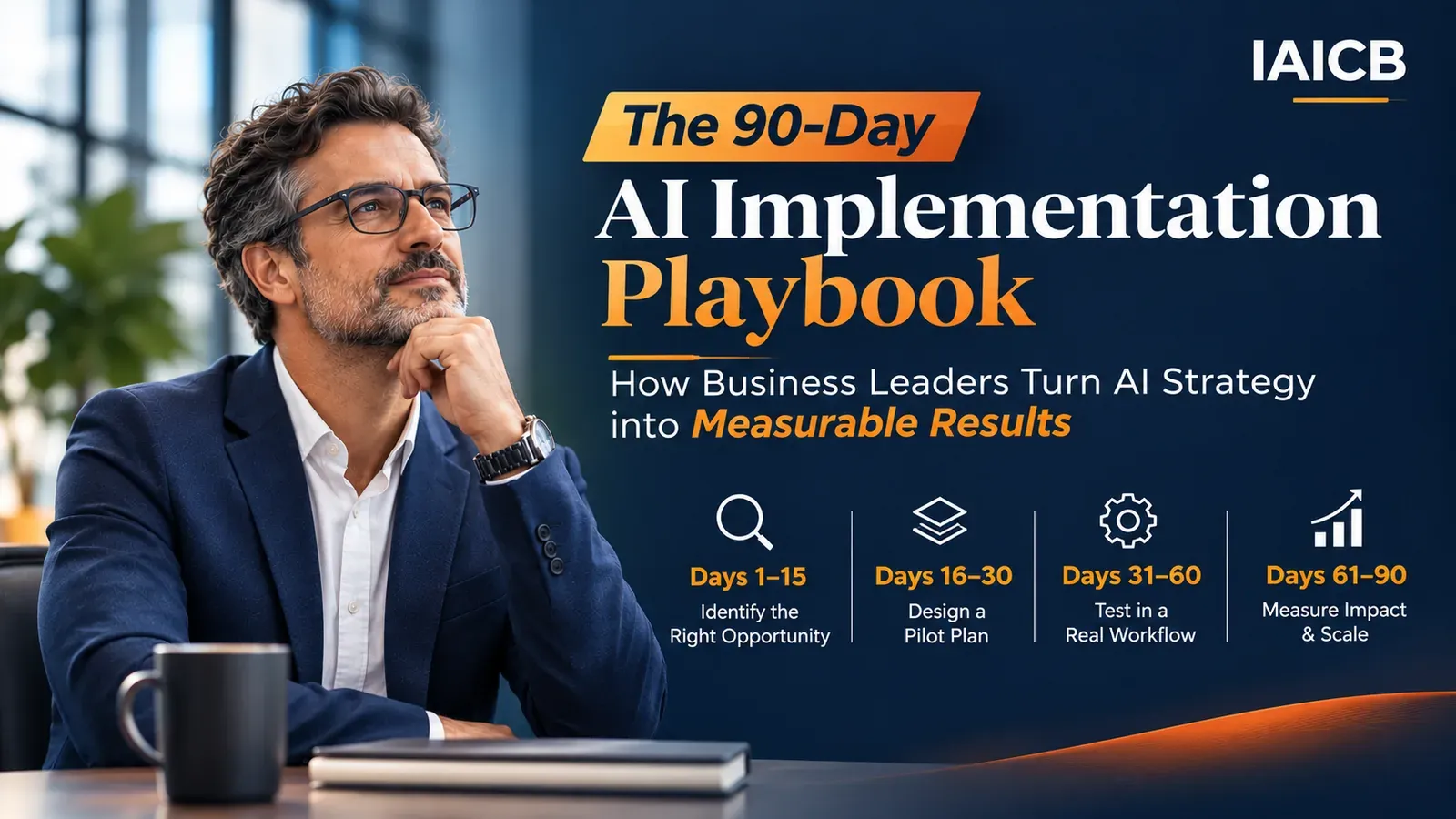
Your 90-Day AI Implementation Roadmap
Days 1–15: Identify the Business Opportunity
Choose a repetitive, time-consuming process where AI could make a measurable difference.
Examples include customer service, invoice processing, marketing operations, and internal knowledge retrieval.
Identify the process owner, document current performance, and establish success metrics.
Days 16–30: Design a Controlled AI Pilot
Evaluate available data, implementation costs, integration requirements, security considerations, and employee involvement.
Choose an appropriate AI solution and define its limitations.
Determine where human approval is required and how performance will be evaluated.
Days 31–60: Test AI in a Real Workflow
Run a controlled pilot with a small employee group.
Measure operational performance, employee feedback, output quality, and actual usage.
Compare the results with your original baseline instead of assuming that AI automatically improves productivity.
Days 61–90: Evaluate Results and Decide Whether to Scale
Calculate benefits against total implementation and operating costs.
Review technical performance, risks, employee adoption, and customer impact.
Scale only when the evidence supports expansion.
A Practical Business Example
Imagine a finance department processing 500 invoices monthly.
Each invoice takes 12 minutes to review manually. An AI-assisted process might reduce this to 8 minutes while retaining human approval.
That represents approximately 33 hours of potential monthly capacity savings.
However, the organization must verify accuracy, additional review costs, and whether the saved time creates measurable financial value.
Knowledge Check
Question 1: What should be the first step when implementing AI?
- A. Purchasing an advanced AI platform
- B. Identifying a business problem and establishing a baseline
- C. Automating several departments simultaneously
Question 2: What should happen if an AI pilot saves time but produces frequent costly errors?
- A. Scale immediately
- B. Ignore the errors
- C. Correct the issues and retest before scaling
Is Your Organization AI-Ready?
Before investing in AI, evaluate five foundations: data quality, business ownership, success measurement, governance, and workforce readiness.
- Data quality — Is the process data accessible, reliable, and secure enough for a pilot?
- Business ownership — Is there a named process owner accountable for outcomes?
- Success measurement — Have you defined a baseline KPI and how improvement will be measured?
- Governance — Are human approval points, security, and risk controls defined?
- Workforce readiness — Will employees be trained and involved in testing and feedback?
Gaps in any of these areas are signals to strengthen foundations before expanding investment.
Free AI Implementation Planning Prompt
Copy and customize this prompt in your preferred AI assistant:
Do not share confidential business information with an unapproved AI tool.
What Happens After Day 90?
Successful AI implementation is not about launching the largest number of AI projects.
It is about improving measurable business outcomes while maintaining quality, human oversight, and responsible governance.
The strongest AI strategies connect technology, people, and business objectives.
Professionals responsible for leading this transformation can explore IAICB's Certified AI Business Professional and Certified AI Strategy Leader certification programs.
Continue Learning
Explore How to Scale AI from Pilot to Production or How to Calculate AI ROI for deeper implementation and investment guidance.
The question is no longer whether your business needs AI. It is how your organization can implement it responsibly and turn that investment into measurable results.
Key takeaways
- Successful AI implementation starts with one defined business process, an owner, and measurable success metrics — not tool purchases alone.
- Use a 90-day roadmap: identify the opportunity (days 1–15), design a controlled pilot (16–30), test in a real workflow (31–60), then decide whether to scale (61–90).
- Compare pilot results to a baseline KPI; do not assume AI automatically improves productivity.
- Scale only when benefits outweigh costs and quality, adoption, and governance evidence support expansion.
- Before investing, assess data quality, business ownership, success measurement, governance, and workforce readiness.