Artificial intelligence is transforming how businesses operate, but moving from an AI experiment to enterprise-wide implementation remains a major challenge.
Many organizations successfully test AI solutions but struggle to integrate them into everyday operations. Challenges such as infrastructure limitations, data quality, governance, implementation costs, and workforce readiness can prevent AI projects from delivering lasting business value.
A successful enterprise AI implementation strategy requires more than developing advanced AI models. It demands structured execution, strong governance, reliable technology partners, and scalable automation.
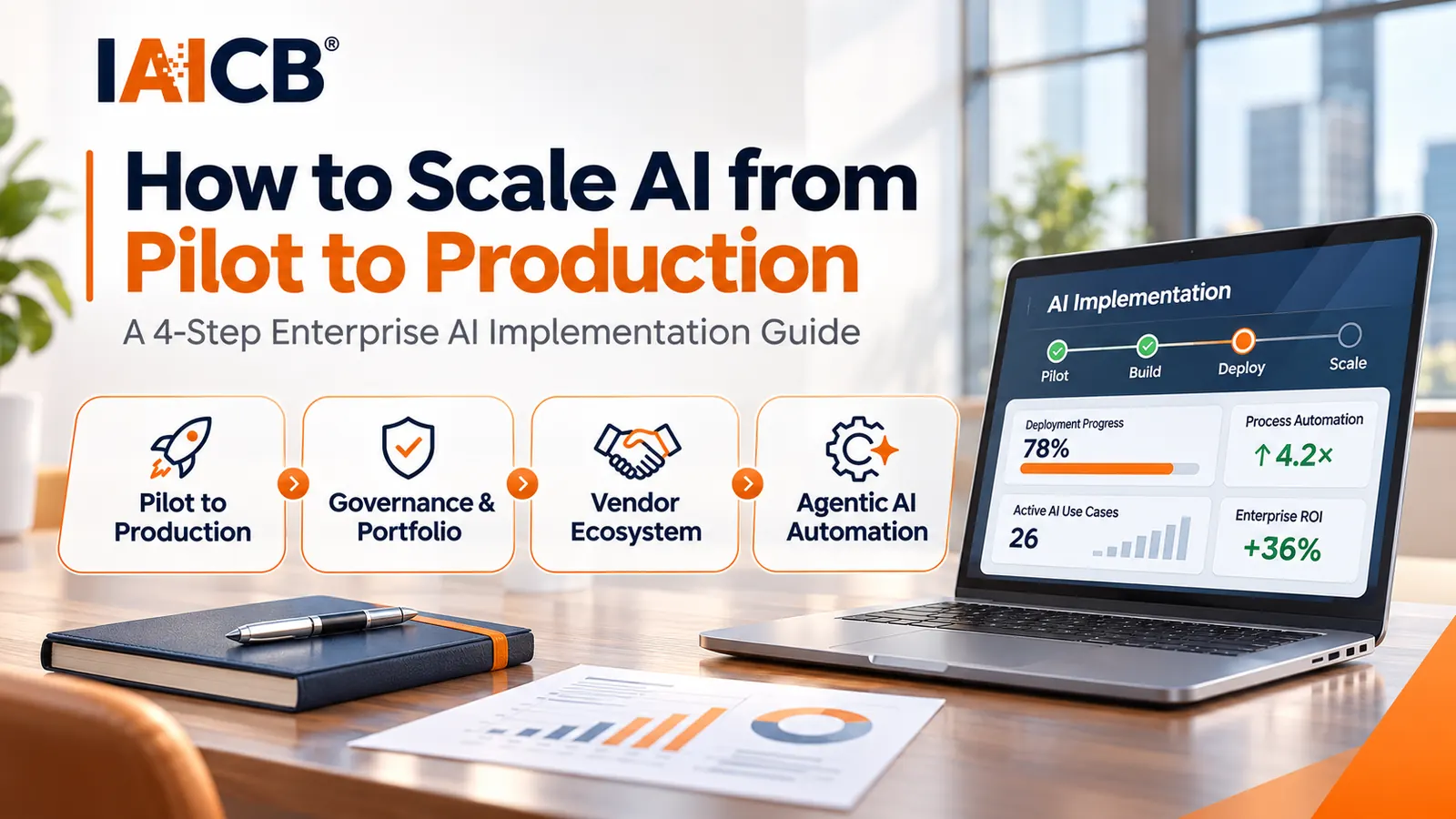
Here is a practical four-step framework to scale AI from pilot to production and achieve sustainable business outcomes.
1. Move from AI Pilot to Production: Overcome the Scaling Gap
An AI pilot demonstrates whether a solution can solve a specific business problem. However, successful experimentation does not guarantee successful production deployment.
Organizations often encounter challenges when moving AI applications into real business environments.
Common obstacles include:
- Data readiness: Ensuring reliable, secure, and accessible data.
- System integration: Connecting AI solutions with existing business applications.
- Infrastructure scalability: Supporting increased workloads and users.
- Operational costs: Managing computing, licensing, and maintenance expenses.
- Performance monitoring: Maintaining accuracy, reliability, and security over time.
For example, a company may successfully test an AI-powered customer support assistant with a small group of employees. Scaling the same solution across departments requires integration with customer databases, security controls, employee training, and continuous monitoring.
The key to scaling AI in business is establishing measurable success criteria, testing performance under realistic conditions, and assigning clear operational ownership before expanding deployment.
2. Establish Strong AI Governance and Portfolio Management
As organizations expand their AI initiatives, effective governance becomes essential.
An AI governance framework defines how AI systems are developed, deployed, monitored, and managed responsibly.
Business leaders should establish policies covering:
- Data privacy, security, and regulatory compliance.
- AI risk assessments and human oversight.
- Accountability for AI-generated decisions.
- Performance monitoring and incident management.
- Responsible and ethical AI usage.
Alongside governance, AI portfolio management helps organizations prioritize projects based on business value, feasibility, strategic importance, and potential risks.
For example, businesses can evaluate AI initiatives using KPIs such as cost savings, productivity improvements, customer satisfaction, and return on investment.
Combining governance with portfolio management ensures that enterprise AI investments remain aligned with business objectives while reducing operational risks.
3. Choose the Right AI Vendors and Technology Ecosystem
Selecting the right technology partners is a critical part of successful enterprise AI implementation.
Organizations must evaluate whether to build AI solutions internally, purchase existing platforms, or collaborate with specialized AI vendors.
Key vendor selection criteria include:
- Scalability: Can the solution support growing business requirements?
- Security: Does the provider meet data protection requirements?
- Integration: Can the AI platform work with existing systems?
- Cost: What are the implementation and ongoing expenses?
- Flexibility: Can the organization avoid excessive vendor dependency?
A strong AI vendor management strategy also considers service-level agreements, data ownership, long-term technical support, and exit options.
Choosing compatible, secure, and scalable technologies helps businesses avoid unnecessary complexity as AI adoption grows.
4. Scale Agentic AI and Enterprise Process Automation
One of the emerging opportunities in enterprise AI is agentic AI, which enables AI-powered systems to perform multistep tasks using tools and workflows within defined boundaries.
Unlike basic automation that follows predefined rules, agentic AI systems can use contextual information to select actions and coordinate tasks toward specified objectives.
Potential applications include:
- Customer service: Coordinating customer inquiries and support workflows.
- Finance: Supporting invoice processing and financial operations.
- Human Resources: Automating administrative workflows and employee support.
- Supply Chain: Assisting with inventory monitoring and procurement processes.
- IT Operations: Supporting incident classification and routine system tasks.
However, scaling agentic AI in enterprises requires appropriate safeguards.
Organizations should establish access permissions, audit trails, performance evaluations, human approval for high-impact actions, and safeguards against unintended behavior.
The goal of enterprise AI automation is not simply to automate more tasks but to improve efficiency, reliability, and business outcomes responsibly.
Why Strategic AI Execution Matters
AI transformation does not end with developing a successful pilot.
Organizations must create a repeatable process for implementing, governing, measuring, and expanding AI solutions.
A structured AI scaling strategy helps business leaders improve investment decisions, reduce implementation risks, and identify opportunities for continuous improvement.
More importantly, it connects AI innovation with measurable enterprise performance.
Frequently Asked Questions
How do you scale AI from pilot to production?
Organizations can scale AI by validating pilot results, preparing infrastructure and data, integrating systems, establishing governance, and continuously monitoring performance.
Why do AI pilots struggle to scale?
Common reasons include poor data quality, integration complexity, unclear business ownership, insufficient governance, and underestimated operational costs.
What is the role of agentic AI in enterprise automation?
Agentic AI can coordinate multistep business processes, interact with approved tools, and support operational workflows while operating under appropriate security controls and human oversight.
Conclusion: Turn AI Experiments into Enterprise Value
Successfully scaling AI requires a balanced approach to technology, strategy, governance, and operational execution.
By overcoming the pilot-to-production gap, establishing strong AI governance, selecting reliable technology partners, and implementing agentic AI responsibly, businesses can build scalable AI capabilities.
The real measure of enterprise AI success is not the number of AI pilots launched, but the measurable business value generated from AI systems running in production.
The real measure of enterprise AI success is not the number of AI pilots launched, but the measurable business value generated from AI systems running in production.
Build the Skills to Scale Enterprise AI
Want to develop the expertise needed to move AI from pilots to production with governance, vendor strategy, and responsible automation?
Explore the Certified AI Strategy Leader (CAISL™) certification offered by the International AI Certification Board (IAICB).
Build your understanding of enterprise AI implementation, AI governance, portfolio prioritization, and organizational transformation.
Key takeaways
- Close the pilot-to-production gap with measurable success criteria, realistic testing, and clear operational ownership.
- Pair an AI governance framework with portfolio management so initiatives stay aligned to value, feasibility, and risk.
- Evaluate AI vendors on scalability, security, integration, cost, and flexibility — including exit options.
- Scale agentic AI for multistep process automation only with permissions, audit trails, and human approval for high-impact actions.
- Measure enterprise AI success by business value from production systems, not by the number of pilots launched.