Artificial intelligence is transforming business operations, but one critical question remains: Is your AI investment delivering measurable returns?
Organizations worldwide are investing in AI-powered automation, predictive analytics, and generative AI. However, successful AI adoption requires more than advanced technology. Business leaders must understand implementation costs, evaluate financial benefits, and measure the actual return on investment.
A structured AI ROI framework helps organizations make informed investment decisions, control costs, and maximize business value.
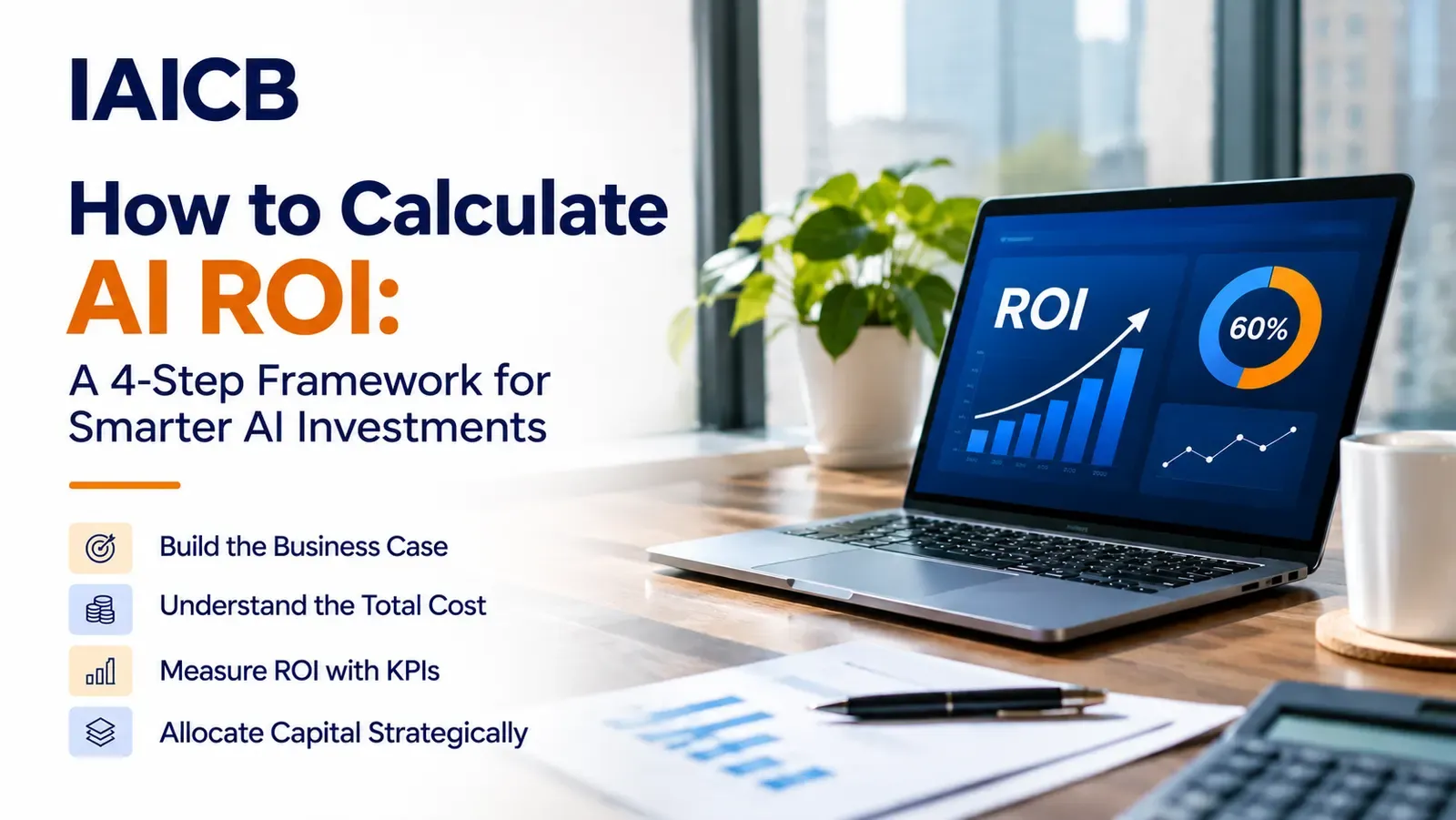
Here are four practical steps to evaluate AI investments effectively.
1. Build a Strong Business Case for AI Investment
Before implementing artificial intelligence, organizations should identify the business challenges they want to solve.
A compelling business case for AI connects technology investments with measurable organizational objectives.
Key considerations include:
- Operational efficiency: Can AI reduce repetitive tasks and improve productivity?
- Revenue growth: Can AI enhance customer experiences or generate new business opportunities?
- Cost reduction: Can automation reduce operational expenses?
- Competitive advantage: Can AI improve decision-making and business performance?
For example, a financial institution implementing AI-powered fraud detection should evaluate potential reductions in fraud losses alongside implementation and operational costs.
A successful AI investment strategy begins with measurable goals rather than adopting technology simply because it is trending.
2. Understand the True Cost of AI Implementation
One of the biggest challenges in calculating AI return on investment is understanding the total cost of adoption.
AI implementation costs extend beyond purchasing software or subscribing to an AI platform.
Organizations should consider:
- Computing Infrastructure: Cloud services, processing power, and storage
- AI Talent: Hiring, training, and specialized expertise
- Software & Licensing: AI platforms, APIs, and subscriptions
- Data & Integration: Data preparation and system integration
- Operations & Maintenance: Monitoring, security, updates, and governance
Evaluating the total cost of ownership (TCO) of AI helps organizations avoid unexpected expenses and develop realistic budgets.
Businesses should also account for ongoing costs as AI applications expand across departments.
3. How to Calculate AI ROI Using KPIs
Measuring the financial success of AI initiatives requires clear performance indicators and a consistent evaluation framework.
The basic AI ROI formula is:
Example: Calculating AI Return on Investment
Suppose a company implements an AI-powered customer support solution.
- Total AI investment: $100,000
- Annual financial benefits: $160,000
- Net financial benefit: $60,000
Assuming the investment includes all relevant costs for the first year:
AI ROI = [($160,000 − $100,000) ÷ $100,000] × 100 = 60%
This hypothetical example demonstrates how organizations can evaluate the financial returns of AI adoption.
However, not every AI benefit translates directly into revenue or savings. Productivity improvements should be financially valued only when they produce measurable benefits, such as reduced expenses or additional productive capacity.
Key AI KPIs to Track
Organizations can measure AI performance through:
- Cost savings and operational efficiency
- Revenue generated or influenced by AI
- Employee productivity improvements
- Customer satisfaction and service quality
- Process accuracy and error reduction
- Time saved through automation
Comparing results against a pre-implementation baseline helps organizations estimate the value attributable to AI.
4. Develop a Smarter AI Investment and Budget Strategy
Not every AI project deserves equal investment.
Organizations should prioritize initiatives based on expected returns, implementation complexity, strategic importance, and potential risks.
An effective AI capital allocation strategy involves:
- Prioritizing high-value use cases: Invest in AI projects with clear business objectives and achievable outcomes.
- Starting with pilot projects: Test AI solutions on a smaller scale before committing significant resources.
- Measuring performance continuously: Monitor AI KPIs, operating costs, and financial benefits.
- Scaling successful initiatives: Expand projects that demonstrate measurable value while improving or discontinuing underperforming investments.
This approach allows businesses to manage financial risks while building a sustainable portfolio of AI initiatives.
Why Measuring AI ROI Matters for Business Leaders
As artificial intelligence becomes part of enterprise strategy, executives must understand both its technological capabilities and financial implications.
Effective AI leadership requires knowledge of AI investment planning, cost-benefit analysis, ROI measurement, and strategic resource allocation.
Organizations that measure AI performance consistently are better positioned to justify investments, improve financial accountability, and support long-term transformation.
Frequently Asked Questions
What is AI ROI?
AI ROI measures the financial return generated by an artificial intelligence investment relative to its total cost.
How do businesses calculate AI ROI?
Businesses calculate AI ROI by subtracting total AI costs from attributable financial benefits, dividing the result by total AI costs, and multiplying by 100.
What are the major costs of implementing AI?
Common costs include computing infrastructure, software licensing, AI talent, data preparation, system integration, security, and ongoing maintenance.
Conclusion: Make Every AI Investment Count
Artificial intelligence can create substantial business value, but achieving positive returns requires careful financial planning and continuous performance measurement.
By developing a strong business case, understanding implementation costs, tracking meaningful KPIs, and prioritizing high-value initiatives, organizations can make smarter AI investment decisions.
The future of successful AI adoption is not simply about investing more in technology. It is about investing strategically and measuring the value created.
Develop the Skills to Lead AI Investment Decisions
Want to strengthen your understanding of enterprise AI strategy, investment planning, and business transformation?
Explore the Certified AI Strategy Leader (CAISL™) certification offered by the International AI Certification Board (IAICB).
Develop the strategic knowledge needed to evaluate AI opportunities, manage investments, and lead AI-driven business transformation.
Key takeaways
- Start with a business case that ties AI to measurable goals — efficiency, revenue, cost reduction, or advantage.
- Budget for total cost of ownership: infrastructure, talent, licensing, data, integration, and ongoing operations.
- Calculate AI ROI as [(Financial Benefits − Total AI Costs) ÷ Total AI Costs] × 100, using clear baselines.
- Track KPIs such as cost savings, revenue influence, productivity, satisfaction, accuracy, and time saved.
- Prioritize high-value use cases, pilot first, measure continuously, and scale only what proves value.