Artificial intelligence is transforming how organizations operate, make decisions, and manage their workforce. However, successful AI adoption requires more than investing in advanced technologies.
Businesses must also prepare their employees, leadership teams, and organizational structures to work effectively with AI.
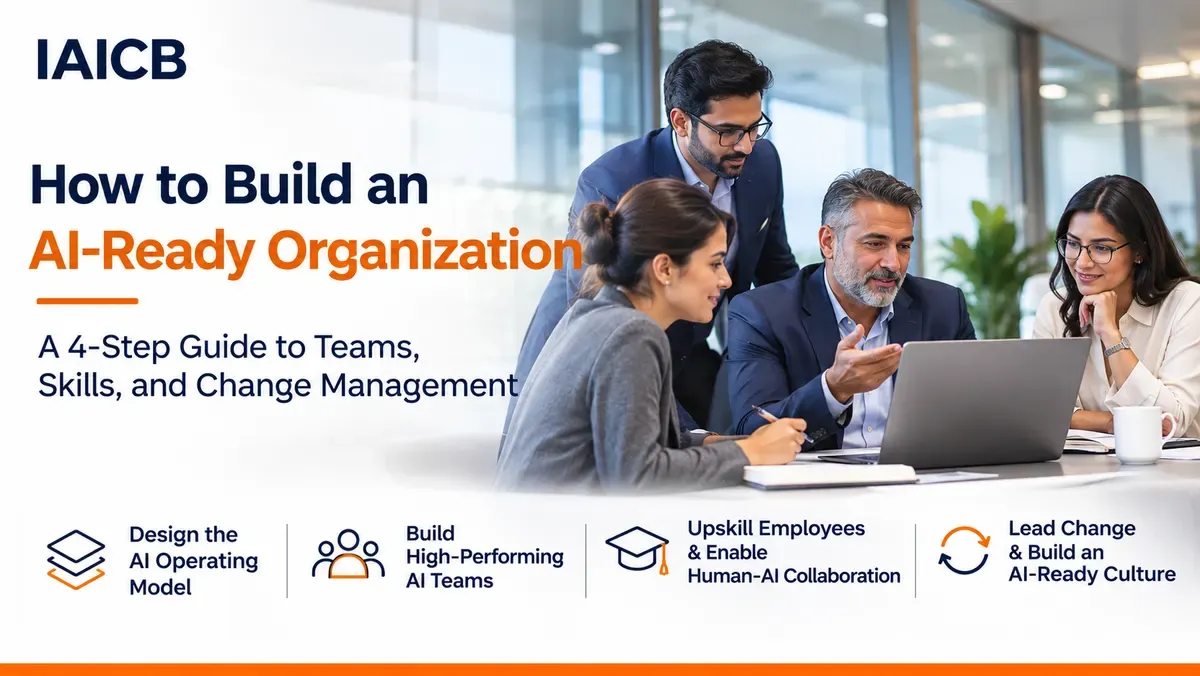
Building an AI-ready organization involves creating the right AI operating model, developing skilled teams, encouraging human-AI collaboration, and managing organizational change.
For CEOs, HR leaders, and business executives, understanding these elements is essential for successful AI organizational transformation.
Here is a practical four-step framework to prepare your organization for an AI-driven future.
1. Design the Right AI Operating Model
An AI operating model defines how an organization manages AI initiatives, allocates responsibilities, and integrates AI into business operations.
Choosing the right structure is essential for scaling AI adoption effectively.
Three common AI operating models include:
- Centralized: A dedicated AI team manages initiatives, technology, and governance across the organization.
- Hub-and-Spoke: A central AI team establishes standards while individual departments implement AI solutions.
- Federated: Business units manage their own AI initiatives within shared organizational policies.
The ideal model depends on an organization's size, AI maturity, technical capabilities, and governance requirements.
For example, a growing business may benefit from a centralized AI team, while a large enterprise might adopt a hub-and-spoke approach to balance innovation with consistency.
A well-designed enterprise AI operating model improves coordination, accountability, and scalability.
2. Build and Lead High-Performing AI Teams
Successful AI initiatives require collaboration between technical specialists and business professionals.
Building high-performing AI teams means bringing together individuals with complementary expertise.
Important roles include:
- AI Engineers: Develop and implement AI-powered applications.
- Data Scientists: Analyze data and build predictive models.
- Business Strategists: Align AI initiatives with organizational objectives.
- AI Product Managers: Coordinate AI development and business implementation.
- AI Governance Specialists: Oversee responsible AI practices, compliance, and risk management.
However, technical expertise alone is not enough.
Effective AI leadership requires clear communication, cross-functional collaboration, defined responsibilities, and measurable performance objectives.
Organizations should encourage teams to focus on solving business problems rather than implementing AI simply for technological innovation.
3. Upskill Employees and Encourage Human-AI Collaboration
As AI becomes integrated into everyday business processes, workforce capabilities must evolve.
AI workforce upskilling helps employees develop the knowledge and practical abilities required to work confidently with AI tools.
Organizations should focus on:
- AI Literacy: Understanding AI capabilities, limitations, and responsible usage.
- Practical AI Skills: Using AI tools to support daily responsibilities.
- Critical Thinking: Evaluating AI-generated insights and recommendations.
- Human-AI Collaboration: Combining human expertise with AI-assisted workflows.
- Continuous Learning: Updating employee skills as technology evolves.
For example, HR professionals can use AI to support recruitment administration, while marketing teams can use generative AI to assist with content development and customer analysis.
In both cases, human oversight remains essential for quality, fairness, and accountability.
The objective of human-AI collaboration is to help employees perform their work more effectively while maintaining appropriate human judgment.
4. Lead AI Change Management and Build an AI-Ready Culture
One of the biggest challenges in AI organizational transformation is managing how people respond to technological change.
Employees may worry about job security, changing responsibilities, or their ability to adapt to new systems.
Effective AI change management addresses these concerns through communication, training, and leadership involvement.
Business leaders should:
- Communicate a clear AI vision: Explain why AI is being introduced and how it supports organizational goals.
- Involve employees early: Encourage teams to participate in identifying AI opportunities and redesigning workflows.
- Provide ongoing training: Help employees gain confidence using AI technologies.
- Establish responsible AI policies: Define expectations around data privacy, transparency, human oversight, and accountability.
- Measure adoption and performance: Track employee engagement, productivity improvements, and the effectiveness of AI-enabled workflows.
Organizations that prioritize transparency, collaboration, and employee development are better positioned to achieve sustainable AI adoption.
Why AI Leadership and Workforce Readiness Matter
AI transformation is not simply a technology initiative. It is an organizational change that affects leadership, talent development, business processes, and workplace culture.
A successful AI adoption strategy combines technology investments with workforce development and effective governance.
Business leaders who understand AI operating models, team development, and change management can make better strategic decisions and guide organizations through complex transformations.
Ultimately, an AI-ready organization is one where people, processes, and technology work together to create measurable business value.
Frequently Asked Questions
What is an AI-ready organization?
An AI-ready organization has the leadership, workforce capabilities, technology, governance, and business processes needed to adopt and manage AI effectively.
What is an AI operating model?
An AI operating model defines how AI initiatives are organized, governed, developed, and deployed across an organization.
Why is workforce upskilling important for AI adoption?
Workforce upskilling helps employees understand AI technologies, develop relevant skills, and collaborate effectively with AI-powered systems.
What is AI change management?
AI change management is the process of helping organizations and employees adapt to AI-driven changes through communication, training, stakeholder engagement, and leadership support.
Conclusion: Prepare Your Organization for an AI-Driven Future
Building an AI-ready organization requires a balanced approach to technology, leadership, talent, and organizational culture.
By establishing the right AI operating model, building capable teams, investing in AI workforce upskilling, and implementing effective AI change management, businesses can create a foundation for sustainable AI transformation.
The organizations best prepared for the future will not necessarily be those adopting the most AI tools, but those that successfully align their people, processes, and technology with clear business objectives.
An AI-ready organization is one where people, processes, and technology work together to create measurable business value.
Develop the Skills to Lead Enterprise AI Transformation
As AI reshapes business operations, organizations need leaders who can connect emerging technologies with strategic decision-making and workforce development.
Explore the Certified AI Strategy Leader (CAISL™) program by IAICB to develop knowledge in enterprise AI strategy, organizational transformation, AI governance, and leadership.
Build the strategic capabilities to lead AI adoption and prepare your organization for the future.
Key takeaways
- Choose an AI operating model — centralized, hub-and-spoke, or federated — that fits size, maturity, and governance needs.
- Build high-performing AI teams that combine technical specialists with business strategists and clear leadership.
- Upskill employees in AI literacy, practical tools, critical thinking, and human-AI collaboration.
- Lead AI change management with a clear vision, early involvement, training, responsible policies, and measured adoption.
- Sustainable AI adoption aligns people, processes, and technology — not tools alone — with business objectives.