Artificial intelligence is evolving faster than ever, transforming how organizations operate, compete, and make strategic decisions.
As we approach 2027, the future of AI in business is moving beyond traditional automation and generative AI toward intelligent systems capable of understanding multiple data formats, executing complex workflows, and supporting enterprise decision-making.
For CEOs, CIOs, and business leaders, understanding emerging AI trends in 2027 is essential for building a competitive advantage.
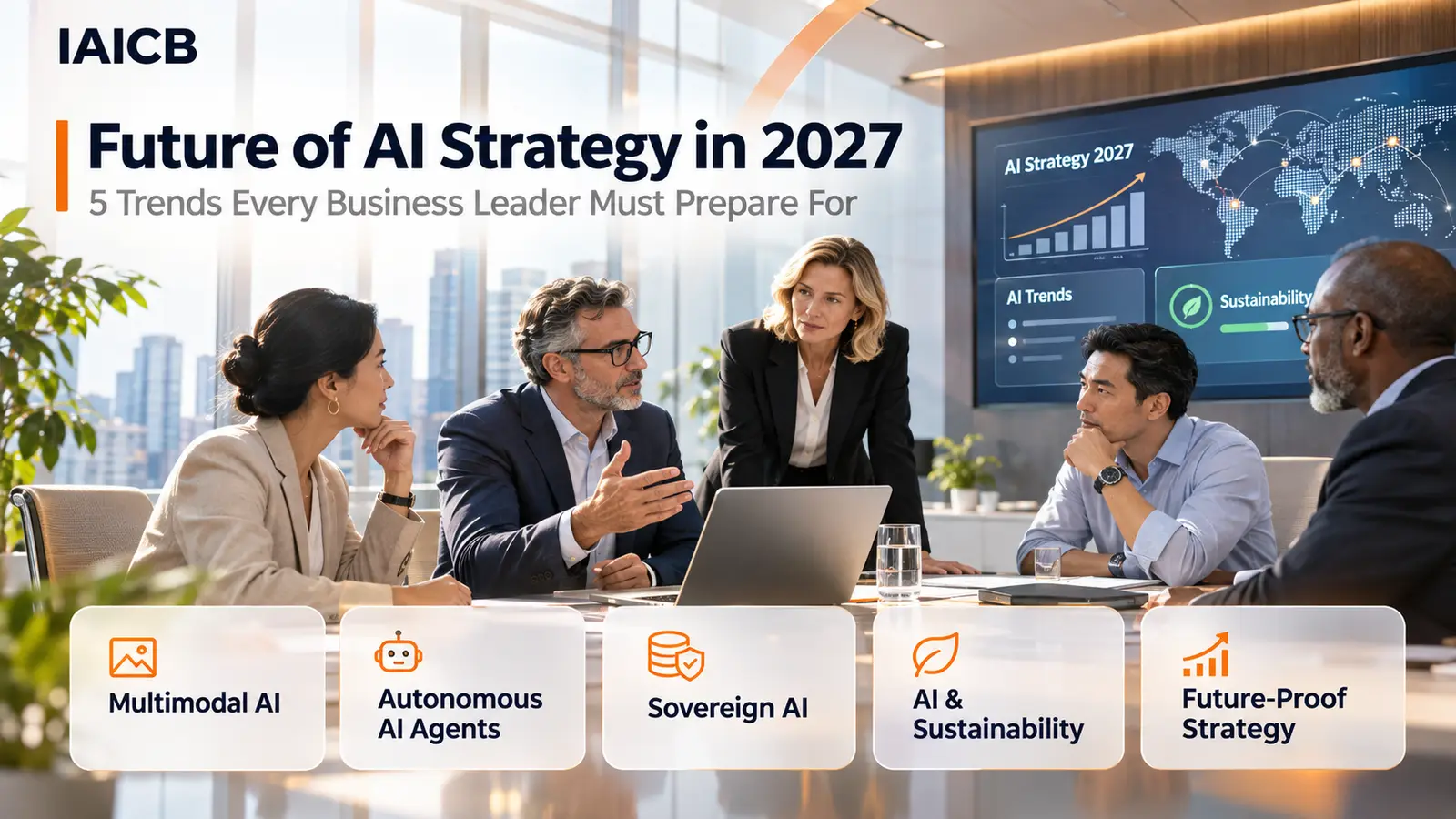
Here are five developments shaping the future of enterprise AI strategy and what organizations should do to prepare.
1. Multimodal AI: The Next Evolution of Business Intelligence
Traditional AI applications often focus on a single type of information, such as text or numerical data.
Multimodal AI can process and connect multiple forms of information, including text, images, audio, and video.
This creates opportunities for businesses to develop more intelligent and interactive applications.
Potential business applications include:
- Customer Experience: AI assistants that understand voice, images, and written queries.
- Healthcare: Supporting analysis of medical images alongside clinical information.
- Manufacturing: Identifying equipment defects using visual and sensor data.
- Business Analytics: Combining documents, conversations, and operational data to generate insights.
For business leaders, multimodal AI represents an opportunity to improve information accessibility and decision support.
However, organizations must evaluate accuracy, privacy, and integration requirements before deploying these systems.
2. Autonomous AI Agents: Moving Beyond Traditional Automation
One of the most significant AI business trends for 2027 is the advancement of autonomous and agentic AI systems.
Unlike conventional AI assistants that primarily respond to user requests, autonomous AI agents can plan and execute multistep workflows using connected tools within defined permissions.
For example, an AI agent could support a procurement workflow by reviewing inventory information, preparing purchase requests, and coordinating approvals.
Other applications include:
- Customer service workflow automation
- IT service management
- Financial reporting assistance
- Supply chain coordination
- Administrative process optimization
Gartner's October 2026 technology outlook highlights AI agent identity, context platforms, and governance as important priorities for organizations preparing for greater autonomy.
The strategic priority: Businesses should focus on deploying AI agents with clear objectives, access controls, monitoring, and human oversight rather than pursuing automation without accountability.
3. Sovereign AI: Greater Control Over Data and Technology
As AI becomes essential to business operations, organizations are increasingly evaluating where their data is stored, how AI models are managed, and which technology providers control critical infrastructure.
Sovereign AI refers to the ability of a country or organization to develop, operate, or control AI capabilities according to its own requirements and priorities.
For enterprises, this raises important questions:
- Where is sensitive business data processed?
- Who controls AI infrastructure and access?
- Can AI solutions comply with applicable local regulations?
- How dependent is the organization on external AI providers?
Sovereign AI strategies may involve regional cloud infrastructure, local AI deployment, stronger data governance, and reducing critical vendor dependencies.
As organizations plan for 2027, AI data sovereignty and operational resilience are becoming important components of enterprise technology strategy.
4. Sustainable AI: Balancing Innovation with Environmental Responsibility
The rapid expansion of AI infrastructure also introduces environmental challenges.
Training and operating AI systems requires computing resources, electricity, and cooling infrastructure.
The International Energy Agency's updated analysis projects that global data center electricity consumption could reach approximately 950 terawatt-hours by 2030, compared with approximately 485 TWh in 2025.
This makes AI and sustainability an important consideration for organizations planning long-term technology investments.
Businesses can support sustainable AI adoption by:
- Selecting energy-efficient AI models and infrastructure.
- Optimizing computing resources and cloud workloads.
- Monitoring energy consumption and environmental impact.
- Incorporating sustainability objectives into AI procurement.
- Using AI to support energy optimization and resource management.
A sustainable AI strategy should balance business performance, cost efficiency, and environmental responsibility.
5. Future-Proofing AI Strategy for 2027 and Beyond
As AI capabilities evolve, organizations must build strategies that can adapt to technological and regulatory changes.
A successful future-proof AI strategy should focus on five priorities:
- Continuous Workforce Upskilling: Equip employees and business leaders with practical AI knowledge.
- Flexible AI Infrastructure: Invest in scalable solutions that support changing technologies and business needs.
- Responsible AI Governance: Establish policies for security, transparency, accountability, and risk management.
- Strategic AI Investments: Prioritize projects that demonstrate measurable business value.
- Continuous Innovation: Regularly evaluate emerging AI technologies and update organizational roadmaps.
Rather than investing in every new AI trend, businesses should identify developments that align with their objectives, capabilities, and long-term strategy.
Frequently Asked Questions
What are the biggest AI trends for 2027?
Important trends to watch include multimodal AI, autonomous AI agents, sovereign AI, sustainable AI, and enterprise-wide AI governance.
How will AI change business strategy in 2027?
AI is expected to influence how organizations automate workflows, analyze information, manage technology infrastructure, and make strategic investment decisions.
How can businesses prepare for future AI developments?
Organizations can prepare by investing in AI skills, strengthening governance, improving data infrastructure, and developing flexible AI implementation roadmaps.
Conclusion: Prepare Today for the Future of AI
The future of AI strategy in 2027 will be shaped by more capable AI systems, greater automation, stronger data sovereignty requirements, and increasing attention to sustainability.
For business leaders, the challenge is not simply keeping pace with emerging technology. It is understanding how to transform innovation into measurable business value.
Organizations that invest in strategic planning, responsible AI governance, and workforce development will be better positioned to navigate the evolving AI landscape.
The challenge is not simply keeping pace with emerging technology — it is transforming innovation into measurable business value.
Develop the Skills to Lead the Future of AI
As artificial intelligence continues to reshape industries, organizations need leaders who understand both emerging technologies and their strategic business implications.
Explore the Certified AI Strategy Leader (CAISL™) program by IAICB to develop knowledge in enterprise AI strategy, governance, emerging technologies, and organizational transformation.
Prepare to lead AI-driven business transformation in 2027 and beyond.
References
Key takeaways
- Multimodal AI connects text, images, audio, and video for richer business intelligence and decision support.
- Autonomous AI agents can plan and execute multistep workflows — with clear objectives, access controls, and human oversight.
- Sovereign AI raises questions of data location, infrastructure control, regulation, and vendor dependency.
- Sustainable AI balances performance with energy use as data center electricity demand continues to rise.
- Future-proof strategy prioritizes upskilling, flexible infrastructure, governance, measurable investments, and continuous innovation.