Artificial intelligence is transforming how businesses operate, compete, and grow. However, adopting AI tools without a clear strategy can lead to wasted investments, disconnected systems, and limited business value.
A successful enterprise AI strategy goes beyond implementing new technology. It aligns AI initiatives with business objectives, evaluates organizational readiness, and creates a structured roadmap for long-term growth.
Whether you're a CEO, business leader, or technology professional, this five-step AI strategy framework will help you turn AI opportunities into measurable business outcomes.
1. Define Your Enterprise AI Vision and Business Goals
Every successful AI transformation begins with a clear vision.
Before investing in AI, organizations must identify the business problems they want to solve and the outcomes they expect to achieve.
Key questions include:
- How can AI improve operational efficiency?
- Where can AI create competitive advantages?
- Which business processes could benefit from automation?
- How will AI contribute to revenue growth and customer experience?
For example, a financial services organization might prioritize AI-powered fraud detection, while a retail business may focus on personalized customer experiences.
The goal is simple: Build an AI vision that supports your organization's broader business strategy rather than adopting AI simply because competitors are doing so.
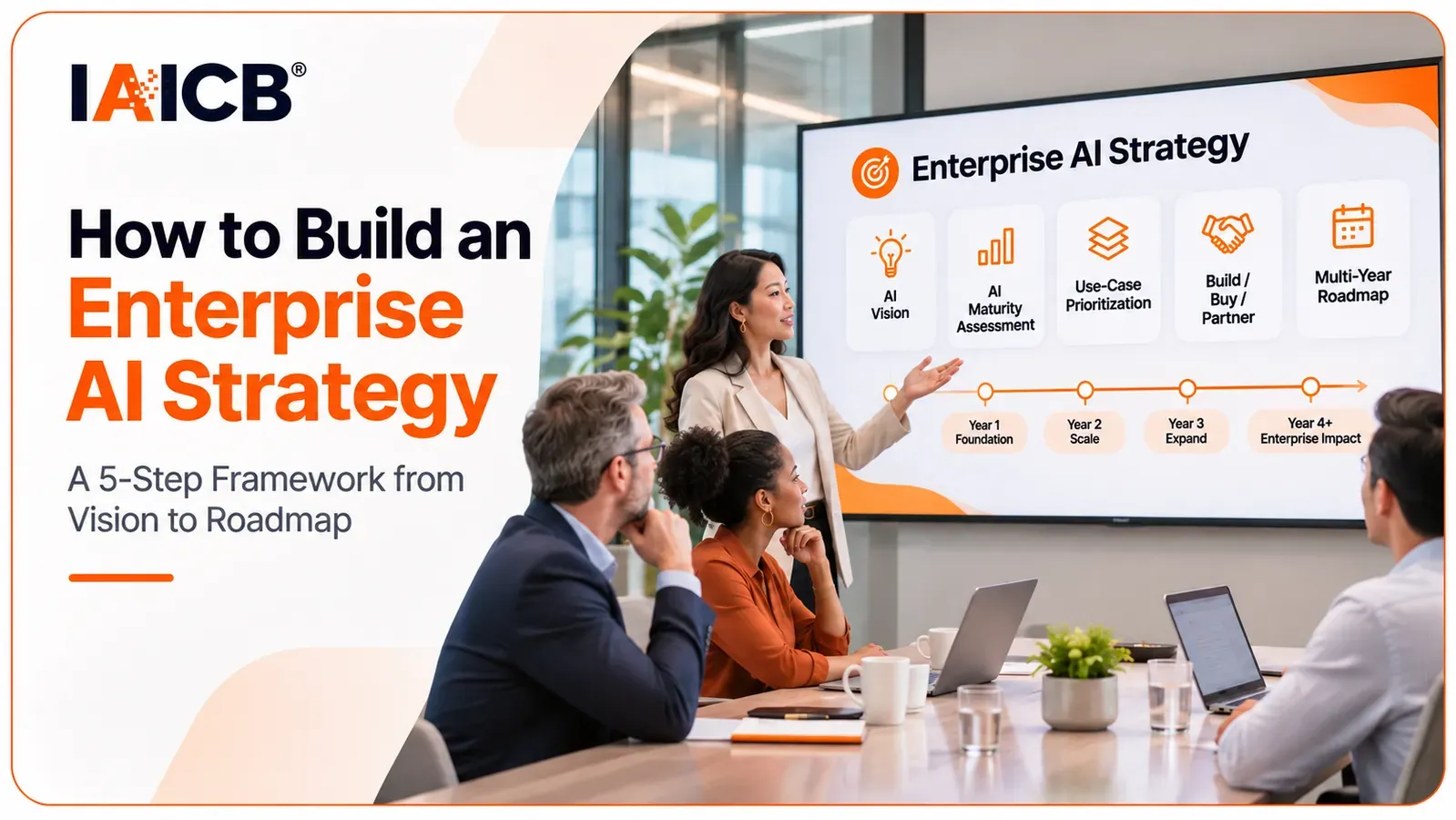
2. Conduct an AI Maturity Assessment
Before implementing AI at scale, organizations need to understand their current capabilities.
An AI maturity assessment evaluates how prepared a business is to adopt, manage, and expand AI technologies.
Five important areas to assess include:
- Data readiness: Is business data accessible, reliable, and secure?
- Technology infrastructure: Can existing systems support AI applications?
- Workforce capabilities: Do employees have the necessary AI skills?
- Leadership readiness: Does management understand AI opportunities and limitations?
- AI governance: Are responsible AI policies, security controls, and risk management practices established?
This AI readiness assessment helps organizations identify gaps and determine where to invest before launching major AI initiatives.
3. Identify and Prioritize High-Value AI Use Cases
Not every AI application delivers the same business value.
Organizations should identify opportunities across departments and prioritize them based on potential impact, implementation feasibility, cost, and risk.
Some practical enterprise AI use cases include:
- Human Resources: Recruitment workflow automation.
- Marketing: Customer segmentation and personalization.
- Finance: Fraud detection and financial forecasting.
- Customer Support: AI-powered virtual assistants.
- Operations: Predictive maintenance and process optimization.
A useful approach is to begin with projects that offer meaningful business benefits and can be implemented with existing resources.
For example, automating repetitive customer support tasks may provide a more practical starting point than building a complex, organization-wide AI platform.
Prioritizing AI use cases strategically helps businesses manage costs, demonstrate value, and build confidence for larger investments.
4. Build, Buy, or Partner: Choose the Right AI Solutions
One of the most important decisions in an enterprise AI strategy is determining how to acquire AI capabilities.
Organizations generally have three options:
- Build: Develop customized AI solutions internally when requirements are highly specialized and technical capabilities are available.
- Buy: Invest in existing AI platforms and software to accelerate implementation and reduce development complexity.
- Partner: Collaborate with AI technology providers or consulting organizations to access specialized expertise.
The right decision depends on budget, technical resources, data security, customization requirements, and long-term scalability.
For many organizations, a hybrid approach offers flexibility: using established AI platforms for standard business functions while developing customized solutions for strategic requirements.
5. Develop a Multi-Year AI Strategic Roadmap
An effective AI implementation roadmap transforms business objectives into achievable milestones.
Instead of attempting enterprise-wide transformation immediately, organizations can adopt a phased approach.
- Phase 1 — Foundation: AI readiness assessment, governance, and workforce training.
- Phase 2 — Implementation: Pilot projects and high-priority AI use cases.
- Phase 3 — Expansion: Integrating successful AI solutions across departments.
- Phase 4 — Optimization: Measuring ROI, improving performance, and scaling innovation.
Each phase should include clear responsibilities, measurable KPIs, investment requirements, and risk management controls.
A well-defined enterprise AI roadmap also allows organizations to adapt as technologies, regulations, and business priorities evolve.
Why Enterprise AI Strategy Matters for Business Leaders
As AI becomes increasingly integrated into business operations, organizations need professionals who understand both technology and strategic decision-making.
Developing expertise in AI strategy, AI governance, AI investment planning, and enterprise transformation can help leaders make informed decisions and guide responsible adoption.
The challenge is no longer simply understanding what AI can do. It is knowing where, when, and how to implement it effectively.
Frequently Asked Questions
What is an enterprise AI strategy?
An enterprise AI strategy is a structured plan for aligning artificial intelligence initiatives with business objectives, technology capabilities, organizational readiness, and long-term growth.
How can a business assess its AI readiness?
Businesses can evaluate their data quality, technical infrastructure, workforce skills, leadership capabilities, and AI governance practices to identify gaps before implementation.
What is an AI implementation roadmap?
An AI implementation roadmap outlines the stages, resources, milestones, and performance indicators required to introduce and scale AI solutions within an organization.
Conclusion: Turn AI Ambition into Business Value
Building an effective enterprise AI strategy requires more than selecting the right technology. It demands clear business objectives, realistic readiness assessments, prioritized use cases, informed investment decisions, and a scalable implementation roadmap.
Organizations that approach AI strategically are better positioned to manage risks, optimize investments, and unlock sustainable business value.
The challenge is no longer understanding what AI can do — it is knowing where, when, and how to implement it effectively.
Build the Skills to Lead Enterprise AI Transformation
Want to develop the expertise needed to formulate and execute enterprise AI strategies?
Explore the Certified AI Strategy Leader (CAISL™) certification offered by the International AI Certification Board (IAICB).
Build your understanding of enterprise AI planning, AI maturity assessments, strategic investment decisions, AI governance, and organizational transformation.
Key takeaways
- Start with an AI vision tied to business goals — not technology for its own sake.
- Run an AI maturity assessment across data, infrastructure, skills, leadership, and governance.
- Prioritize high-value use cases by impact, feasibility, cost, and risk.
- Choose build, buy, or partner based on resources, security, and customization needs — hybrids often work best.
- Use a phased multi-year roadmap with clear KPIs so AI scales without uncontrolled risk.