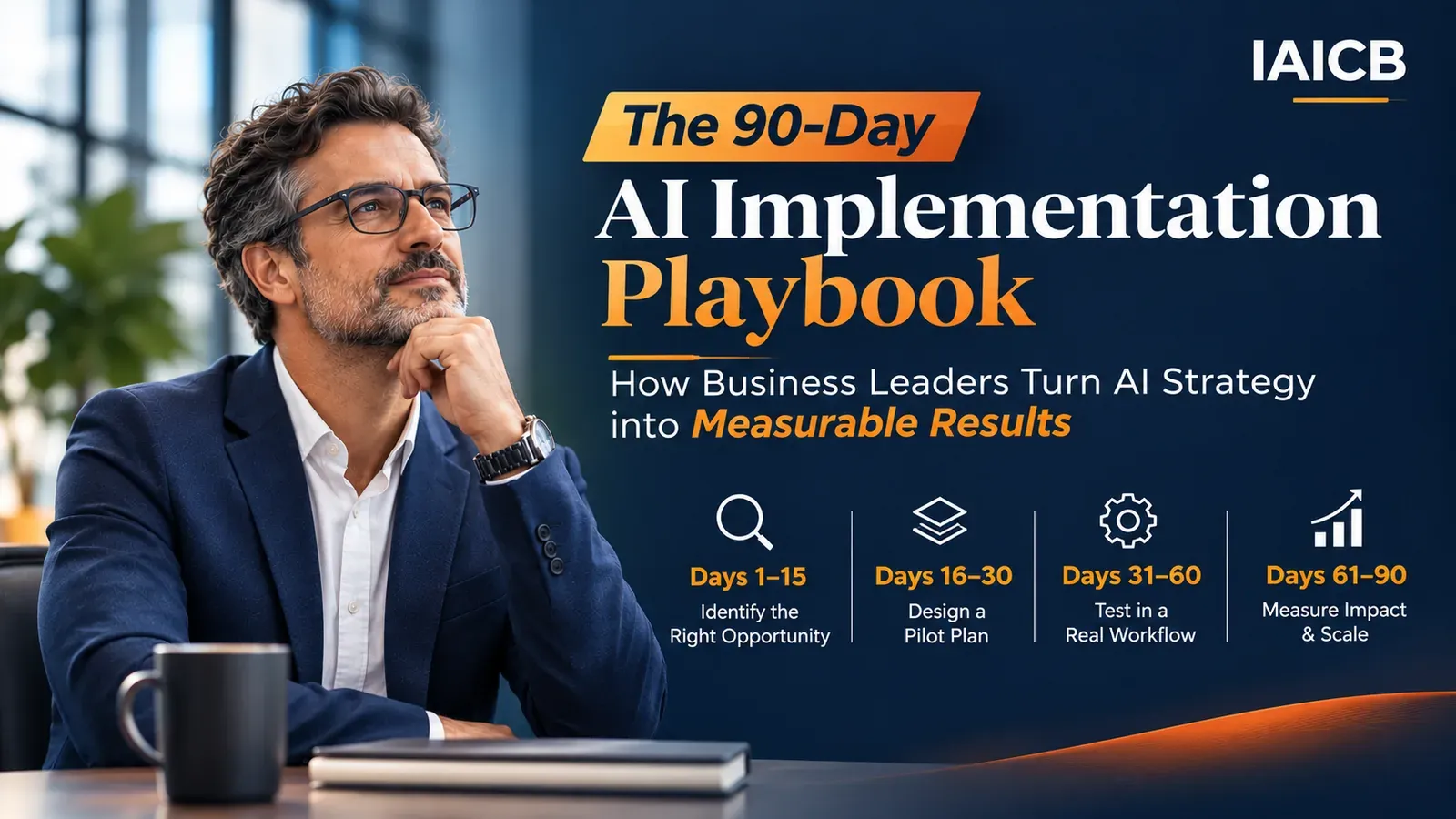
Artificial intelligence is transforming how businesses operate, but implementing AI successfully requires more than choosing the right technology.
Many organizations begin AI initiatives with ambitious goals but struggle with unclear objectives, poor data quality, unexpected costs, and implementation challenges.
Effective AI project management helps businesses turn promising AI ideas into practical solutions that deliver measurable results.
Whether you're a business leader, project manager, or working professional, this seven-step AI implementation framework will help you plan, execute, and manage AI projects successfully.
1. Define the Business Problem and Project Scope
Every successful AI project begins with a clearly defined business problem.
Before selecting AI tools, organizations should identify what they want to achieve and whether AI is the appropriate solution.
Important questions include:
- What business problem are we trying to solve?
- How can AI improve the existing process?
- Who will benefit from the solution?
- What results will define project success?
For example, a customer service department might implement an AI chatbot to reduce response times and automate frequently asked questions.
A well-defined AI project scope helps prevent unnecessary complexity, control costs, and maintain alignment with business goals.
2. Build a Strong Business Case and Assess Data Readiness
Before investing in AI, businesses must evaluate the expected benefits, implementation costs, and availability of reliable data.
A strong AI business case should include:
- Expected cost savings and productivity improvements.
- Technology, infrastructure, and licensing expenses.
- Workforce training and implementation requirements.
- Data quality, accessibility, and security.
- Potential financial and operational risks.
For example, a retail company planning an AI-powered demand forecasting system must ensure it has reliable historical sales and inventory data.
Without adequate data readiness, even advanced AI models may deliver inaccurate results.
3. Select the Right AI Vendors and Build Your Project Team
Choosing suitable technology partners is an important part of AI project planning.
Organizations must decide whether to develop AI solutions internally, purchase existing software, or collaborate with specialized AI providers.
When evaluating vendors, consider:
- Implementation and ongoing costs.
- Data privacy and security.
- Integration with existing systems.
- Scalability and technical support.
- Long-term flexibility and vendor dependency.
Successful AI initiatives also require collaboration between business stakeholders, technical teams, project managers, and compliance professionals.
Clear responsibilities help ensure that everyone understands the project's objectives and expected outcomes.
4. Create an AI Implementation Roadmap
An effective AI implementation roadmap converts business objectives into manageable project milestones.
Instead of attempting a large-scale rollout immediately, organizations should begin with smaller, measurable initiatives.
A practical AI project lifecycle includes:
- Planning: Define objectives, requirements, and success metrics.
- Development: Configure or build the AI solution.
- Testing: Evaluate accuracy, usability, security, and reliability.
- Pilot Deployment: Introduce AI to a limited group of users.
- Scaling: Expand implementation based on validated results.
For example, a company might test an AI-powered HR assistant within one department before introducing it across the organization.
This phased approach helps businesses identify challenges early and improve the solution before wider deployment.
5. Establish AI Governance and Manage Organizational Change
Successful AI implementation requires strong governance and employee involvement.
An AI project governance framework establishes policies and responsibilities for responsible AI adoption.
Key considerations include:
- Data privacy and cybersecurity.
- AI accuracy, fairness, and transparency.
- Human oversight and accountability.
- Regulatory compliance.
- Employee training and stakeholder communication.
Organizations must also prepare employees for changes in their daily workflows.
For example, introducing AI-powered automation may require employees to learn new tools, review AI-generated outputs, and adapt existing processes.
Effective AI change management helps organizations improve adoption while maintaining employee confidence and operational accountability.
6. Deploy AI Solutions and Measure ROI
Deploying an AI solution is not the final stage of a project. Organizations must continuously monitor its performance and business impact.
AI project ROI helps businesses understand whether their investment is delivering measurable financial value.
A basic formula is:
For example, suppose an organization invests $50,000 in an AI automation solution and generates $80,000 in attributable financial benefits during the same measurement period.
The AI project delivers a hypothetical 60% ROI.
Important performance indicators include:
- Operational cost savings.
- Employee productivity improvements.
- Customer satisfaction.
- Revenue growth.
- Process accuracy and efficiency.
- AI adoption rates.
Regular performance reviews help businesses optimize their AI investments and identify opportunities for improvement.
7. Learn from AI Project Failures and Develop a 30-Day Action Plan
AI projects can fail when organizations overlook business alignment, data readiness, stakeholder engagement, or operational requirements.
Common AI project management mistakes include:
- Starting without clear business objectives.
- Underestimating implementation costs.
- Using incomplete or unreliable data.
- Failing to involve employees.
- Ignoring AI governance and performance monitoring.
To reduce these risks, organizations can follow a simple 30-day AI project planning framework.
- Week 1: Identify the business problem and define measurable objectives.
- Week 2: Assess data readiness, costs, and potential benefits.
- Week 3: Evaluate vendors, build the project team, and establish governance.
- Week 4: Finalize the pilot roadmap, success metrics, and approval criteria.
This preparation framework helps organizations establish a foundation before beginning full-scale implementation.
Frequently Asked Questions
What is AI project management?
AI project management is the process of planning, developing, implementing, monitoring, and governing artificial intelligence initiatives to achieve specific business objectives.
Why do AI projects fail?
Common causes include unclear objectives, poor data quality, unrealistic expectations, inadequate governance, and insufficient stakeholder involvement.
Do you need coding skills to manage AI projects?
Not necessarily. Business professionals can manage AI initiatives by understanding business requirements, AI capabilities, project planning, vendor management, governance, and performance measurement.
How can businesses measure AI project success?
Organizations can evaluate financial ROI, productivity improvements, customer satisfaction, adoption rates, operational efficiency, and other relevant business KPIs.
Conclusion: Turn AI Ideas into Measurable Business Value
Successful AI project management requires a structured approach that connects technology with business objectives.
By defining clear goals, building strong business cases, selecting reliable vendors, developing implementation roadmaps, establishing governance, and measuring ROI, organizations can improve their chances of achieving successful AI outcomes.
The key is not simply implementing artificial intelligence but ensuring that every AI initiative creates meaningful and sustainable business value.
Develop the Skills to Lead Successful AI Projects
As businesses accelerate AI adoption, professionals who understand AI project planning, implementation, governance, and business strategy can play an important role in organizational transformation.
Explore the Certified AI Business Professional program offered by the International AI Certification Board (IAICB).
Develop practical knowledge of AI applications, business automation, project management, and responsible AI adoption.
Explore the Certified AI Business Professional Certification and strengthen your ability to manage AI initiatives confidently.
Key takeaways
- Define the business problem and AI project scope before selecting tools or vendors.
- Build a realistic business case that includes costs, benefits, risks, and data readiness.
- Choose vendors and assemble a cross-functional team with clear ownership.
- Use a phased AI implementation roadmap: plan, develop, test, pilot, then scale.
- Establish AI governance, manage change, measure ROI, and prepare with a 30-day planning framework.