Machine learning is one of the most important technologies driving artificial intelligence today. From recommendation systems and fraud detection to generative AI and intelligent automation, machine learning powers many applications we use every day.
However, beginners often struggle with one question: Where should I start learning machine learning?
Becoming an AI developer requires more than understanding algorithms. It involves learning how to train models, evaluate their performance, build neural networks, and work with technologies such as transformers and natural language processing (NLP).
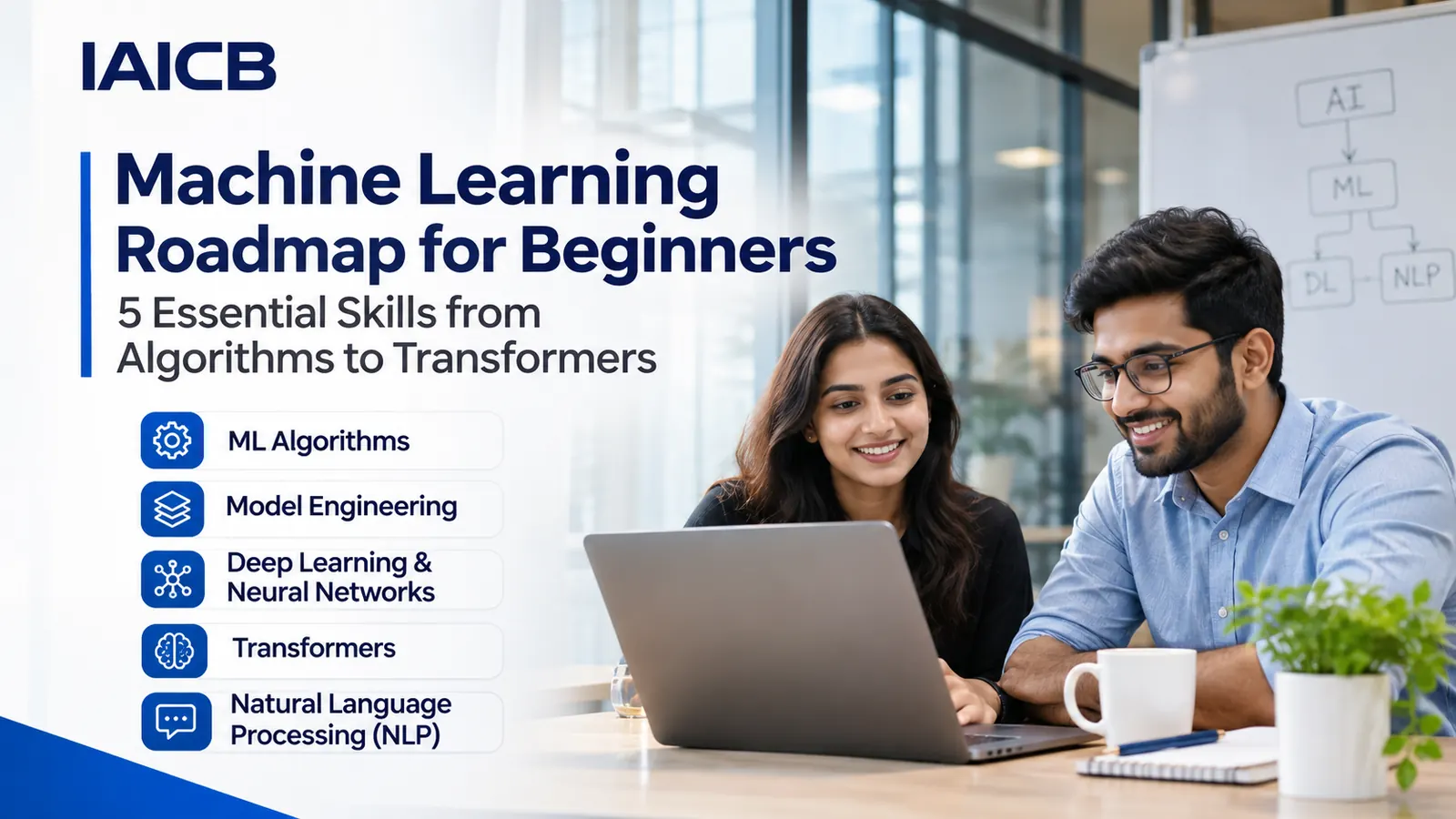
This machine learning roadmap for beginners breaks down five essential skills to help you build a strong foundation in AI development.
1. Understand Core Machine Learning Algorithms
The first step in learning machine learning is understanding how computers identify patterns and make predictions from data.
Machine learning is generally divided into three major approaches:
- Supervised Learning: Models learn from labeled data to predict outcomes.
- Unsupervised Learning: Models discover patterns and relationships in unlabeled data.
- Reinforcement Learning: Models learn to make decisions through interactions and rewards.
Some important machine learning algorithms include:
- Linear Regression — Predicting prices and numerical values.
- Logistic Regression — Binary classification.
- Decision Trees — Classification and decision-making.
- Random Forest and XGBoost — Predictive analytics.
- k-Means and DBSCAN — Customer segmentation and clustering.
- Support Vector Machines (SVMs) — Classification tasks.
For example, an e-commerce company might use machine learning to predict customer purchasing behavior or recommend relevant products.
2. Learn Machine Learning Model Training and Evaluation
Building a machine learning model is only the beginning. Understanding whether it performs reliably is equally important.
Machine learning model evaluation helps developers measure accuracy, identify weaknesses, and improve predictive performance.
Essential concepts include:
- Training and Test Data: Dividing datasets to evaluate performance on unseen information.
- Cross-Validation: Testing models across multiple data splits.
- Hyperparameter Tuning: Optimizing model settings to improve results.
- Overfitting and Underfitting: Understanding when models learn too much or too little from training data.
- Performance Metrics: Using accuracy, precision, recall, F1-score, and RMSE where appropriate.
For example, when developing a fraud detection system, accuracy alone may be misleading because fraudulent transactions are relatively uncommon.
Metrics such as precision and recall help developers better evaluate how effectively the model identifies suspicious activity.
Learning these AI model engineering skills is essential for developing reliable machine learning applications.
3. Master Deep Learning and Neural Networks
Once you understand traditional machine learning, the next step is exploring deep learning and neural networks.
Deep learning uses multilayer neural networks to identify complex patterns in data.
Important neural network architectures include:
- Artificial Neural Networks (ANNs): General-purpose networks for learning patterns.
- Convolutional Neural Networks (CNNs): Commonly used in image recognition and computer vision.
- Recurrent Neural Networks (RNNs): Designed to process sequential information.
- Long Short-Term Memory Networks (LSTMs): A type of RNN designed to capture longer-range relationships in sequences.
Two popular frameworks for deep learning development are PyTorch and TensorFlow/Keras.
PyTorch is widely used in research and deep learning development, while TensorFlow and Keras provide tools for building, training, and deploying neural networks.
For beginners, developing a simple image classification model using PyTorch or TensorFlow is a useful way to gain practical experience.
4. Understand Transformers and Attention Mechanisms
Transformers have become foundational to many modern artificial intelligence systems, including large language models.
Unlike traditional recurrent architectures, transformer models use attention mechanisms to evaluate relationships between different parts of an input sequence.
Important concepts include:
- Self-Attention: Helps models determine which tokens or elements are most relevant to one another.
- Encoder Architecture: Builds contextual representations of input information.
- Decoder Architecture: Generates output sequences, often one token at a time.
- Encoder-Decoder Models: Combine input understanding and output generation, making them useful for tasks such as translation and summarization.
Many modern generative AI applications rely on transformer-based architectures.
Understanding transformers in machine learning provides an important foundation for learning large language models, generative AI, and advanced NLP systems.
5. Explore Natural Language Processing (NLP)
Natural Language Processing (NLP) enables computers to analyze, understand, and generate human language.
It powers applications such as chatbots, translation systems, sentiment analysis, document processing, and search engines.
Essential NLP concepts include:
- Text Preprocessing: Preparing text data for analysis.
- Tokenization: Breaking text into words, subwords, or tokens.
- Word Embeddings: Representing language numerically using techniques such as Word2Vec.
- BERT: A transformer-based language model that learns contextual representations of text.
- Sentiment Analysis: Identifying positive, negative, or neutral opinions in text.
For example, a business can use sentiment analysis to examine customer reviews and identify common satisfaction issues.
Learning NLP helps aspiring AI developers understand how intelligent systems process language and support real-world business applications.
How to Start Your Machine Learning Learning Journey
If you're a beginner, follow this practical learning sequence:
- Foundation — Python, statistics, NumPy, pandas, and basic mathematics.
- Machine Learning — Regression, classification, clustering, and scikit-learn.
- Model Engineering — Evaluation metrics, cross-validation, and optimization.
- Deep Learning — Neural networks, PyTorch, and TensorFlow.
- Advanced AI — Transformers, NLP, BERT, and generative AI fundamentals.
Start with small projects, practice with real datasets, and gradually move toward more complex applications.
Frequently Asked Questions
Is machine learning difficult for beginners?
Machine learning requires programming and mathematical foundations, but beginners can learn progressively through structured lessons and practical projects.
Should I learn machine learning before deep learning?
Yes. Understanding traditional machine learning concepts makes it easier to understand neural networks and advanced deep learning architectures.
Which programming language is best for machine learning?
Python is a popular choice because of its extensive ecosystem, including scikit-learn, PyTorch, TensorFlow, NumPy, and pandas.
What skills are required to become an AI developer?
Important skills include Python programming, machine learning algorithms, model evaluation, neural networks, deep learning frameworks, transformers, and NLP.
Conclusion: Build Your Foundation for a Career in AI
Learning machine learning is a progressive journey that begins with fundamental algorithms and advances toward deep learning, transformers, and intelligent language systems.
By following a structured machine learning roadmap, beginners can develop the technical knowledge needed to build, evaluate, and improve AI applications.
The key is to combine theoretical understanding with practical implementation.
Take the Next Step Toward Becoming an AI Developer
Want to build your machine learning and AI development skills through a structured learning pathway?
Explore the Certified AI Developer (CAID) certification by IAICB.
The program covers essential AI development topics, including machine learning algorithms, model engineering, neural networks, deep learning frameworks, transformers, and natural language processing.
Explore the Certified AI Developer Program and develop the skills needed for modern AI development.
Key takeaways
- Start with core ML algorithms — supervised, unsupervised, and reinforcement learning — before advanced models.
- Treat model training and evaluation as core skills: metrics, cross-validation, and overfitting matter as much as algorithms.
- Move from classical ML into deep learning with ANNs, CNNs, RNNs/LSTMs, and frameworks like PyTorch or TensorFlow.
- Learn transformers and attention so you can understand modern generative AI and large language models.
- Add NLP fundamentals — tokenization, embeddings, BERT, and sentiment analysis — to apply ML to language tasks.