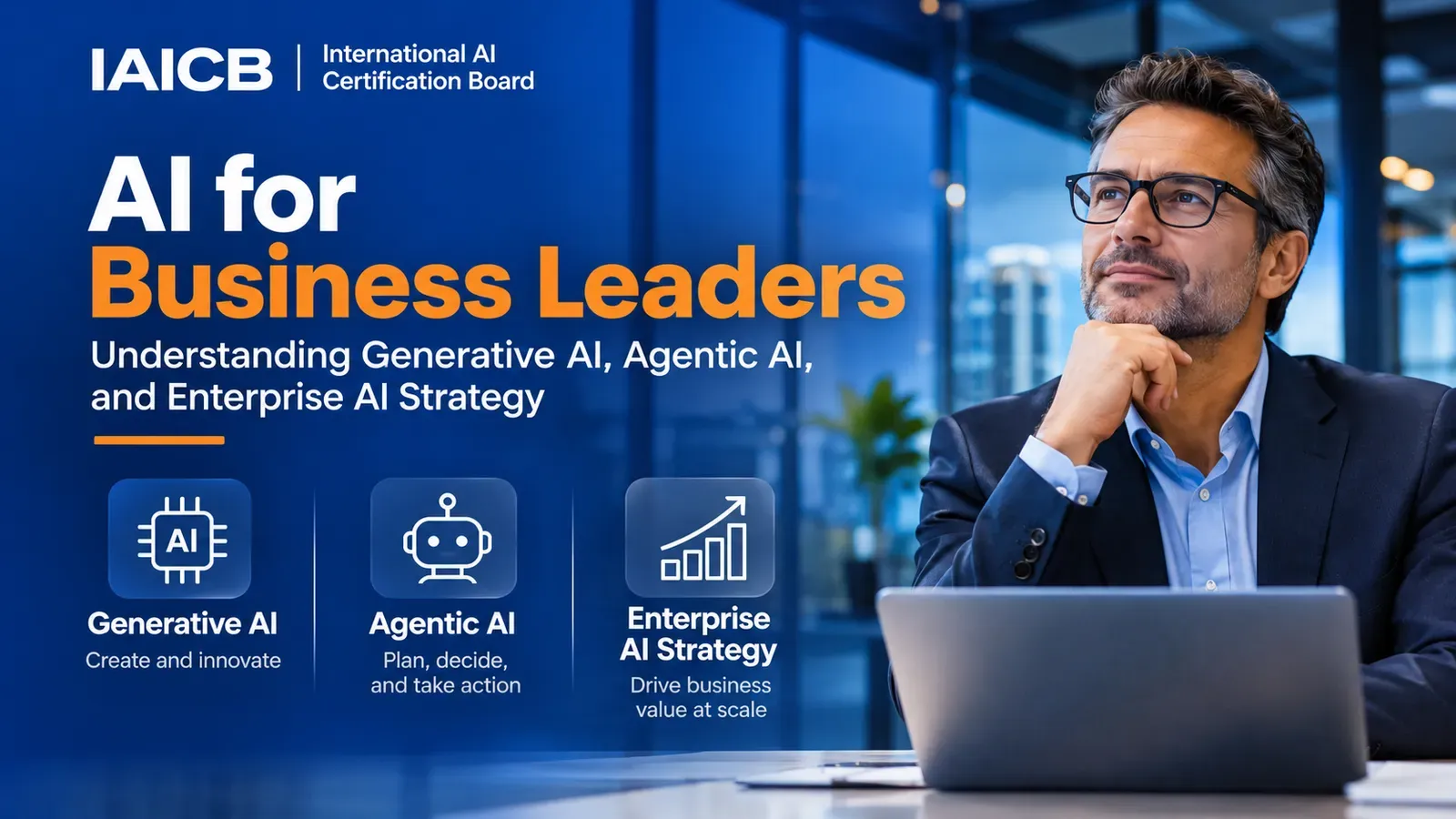
Artificial intelligence is no longer just a technology discussion. It has become an important part of business strategy, influencing how organizations operate, make decisions, and serve customers.
For business leaders, understanding AI does not mean learning to code. It means knowing what AI can do, where it creates value, and how to implement it responsibly.
From Generative AI to Agentic AI, the opportunities are expanding. But how can business leaders distinguish meaningful innovation from hype?
Understanding the AI Landscape: Predictive AI vs. Generative AI vs. Agentic AI
Not all AI systems work the same way. Understanding the differences is the first step toward making informed business decisions.
1. Predictive AI: Anticipating What Happens Next
Predictive AI analyzes historical data to identify patterns and forecast possible outcomes.
For example, businesses use predictive AI to forecast sales, estimate customer churn, and identify financial risks.
2. Generative AI: Creating New Content
Generative AI creates text, images, code, and other content based on learned patterns.
Tools such as ChatGPT can help businesses draft reports, summarize documents, develop marketing content, and improve knowledge-sharing workflows.
3. Agentic AI: Moving from Answers to Actions
Agentic AI goes beyond generating responses. It can plan and execute multi-step tasks using tools and connected systems, within defined permissions.
For example, an AI agent could review customer inquiries, retrieve relevant information, update a CRM, and prepare follow-up communications.
For business leaders, the key distinction is simple: Predictive AI forecasts, Generative AI creates, and Agentic AI can take action.
How Do AI Systems Actually Learn?
Most modern AI systems rely on machine learning, where algorithms learn patterns from data rather than following only explicitly programmed rules.
Large Language Models (LLMs), which power many generative AI applications, are trained on extensive datasets to recognize language patterns and generate responses.
However, AI does not always understand business context or produce accurate information. Its output depends on factors such as training, system design, available data, and human oversight.
Understanding these fundamentals helps executives evaluate AI solutions without needing deep technical expertise.
How AI Is Transforming Enterprise Operations
Businesses can explore AI across multiple functions:
- Human Resources: Supporting recruitment workflows, employee queries, and workforce analytics.
- Marketing: Generating content, analyzing customer behavior, and personalizing communications.
- Finance: Assisting with forecasting, document processing, and anomaly detection.
- Customer Support: Automating routine inquiries and helping support teams retrieve information.
- Operations: Streamlining repetitive processes and improving workflow efficiency.
The objective should not be automation for its own sake. Successful enterprise AI adoption starts with identifying problems where AI can deliver measurable business value.
AI Capabilities vs. Limitations: Separating Reality from Hype
Despite its potential, AI comes with important limitations.
Generative AI can produce inaccurate information, while agentic systems may take incorrect actions if they lack appropriate controls. Data privacy, cybersecurity, bias, and accountability also require attention.
Business leaders should ask three questions before implementing an AI solution:
- What specific business problem will this solve?
- How will we measure its value and performance?
- What safeguards and human oversight are necessary?
Responsible AI adoption requires balancing innovation with governance, transparency, and risk management.
Building an Effective Enterprise AI Strategy
A strong enterprise AI strategy connects technology investments with organizational objectives.
Business leaders can begin with five practical steps:
- Identify opportunities: Find workflows where AI can reduce repetitive work or improve decisions.
- Prioritize use cases: Evaluate potential business value, implementation costs, data readiness, and risks.
- Start with a pilot: Test AI on a manageable project before expanding.
- Measure outcomes: Track relevant metrics such as productivity, quality, customer experience, and return on investment.
- Build AI capabilities: Equip employees and decision-makers with the knowledge needed to adopt AI responsibly.
The most effective AI initiatives are not necessarily the most technically advanced. They are the ones aligned with clear business outcomes.
Why AI Leadership Skills Matter
As organizations adopt AI, business leaders need more than an understanding of AI tools. They need the ability to evaluate investments, manage implementation risks, guide teams, and make informed strategic decisions.
Developing these capabilities through structured learning can help professionals approach AI transformation with greater confidence.
Explore the Certified AI Strategy Leader (CAISL™) programme from the International AI Certification Board (IAICB) to build the skills needed to lead responsible AI adoption.
Conclusion
The future of business leadership is not about replacing human judgment with artificial intelligence. It is about knowing when and how to use AI to make better decisions.
By understanding Generative AI, Agentic AI, and enterprise AI strategy, business leaders can identify meaningful opportunities, manage risks, and prepare their organizations for an increasingly AI-driven business environment.
The competitive advantage will come not simply from adopting AI, but from using it strategically and responsibly.
Key takeaways
- Predictive AI forecasts, Generative AI creates, and Agentic AI can take action within defined permissions.
- Leaders do not need to code — they need clarity on value, limits, measurement, and oversight.
- Enterprise AI adoption starts with business problems that deliver measurable outcomes, not automation for its own sake.
- Ask three questions before implementing AI: what problem it solves, how value is measured, and what safeguards are required.
- A practical strategy follows five steps: identify opportunities, prioritize use cases, pilot, measure, and build AI capabilities.