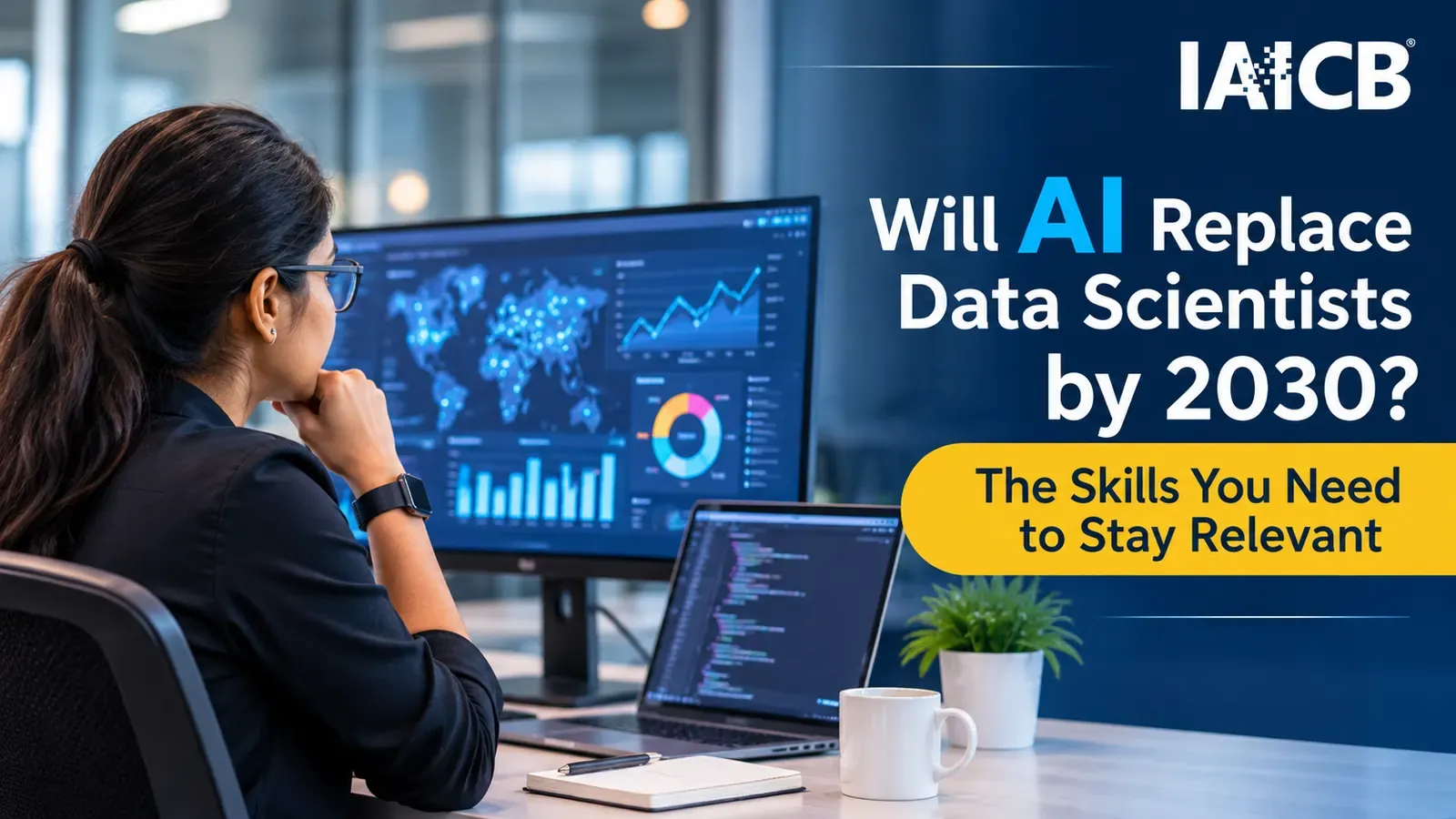
Artificial Intelligence is transforming how businesses collect, analyse and interpret data. Tasks that once required hours of manual work can now be completed in minutes using AI-powered tools. From automated data cleaning to predictive analytics and machine learning, AI is changing the traditional role of data scientists.
But does this mean data scientists will become irrelevant by 2030?
The short answer is no. However, the role of a data scientist is changing rapidly.
Professionals who adapt to AI-powered technologies will have an advantage, while those who rely only on traditional data analysis skills may find it increasingly difficult to remain competitive.
How Is AI Changing Data Science?
AI is automating several repetitive and time-consuming tasks traditionally performed by data scientists. Some examples include:
- Data cleaning — AI tools can identify missing values, inconsistencies and errors in datasets.
- Predictive analytics — machine learning models can analyse historical data to forecast future trends.
- Automated reporting — AI can generate reports, dashboards and data summaries.
- Model development — Automated Machine Learning (AutoML) can simplify model selection and optimisation.
- Data visualisation — AI-powered platforms can generate visual insights from complex datasets.
These developments are improving productivity and allowing data professionals to focus on more strategic responsibilities.
Which Data Science Tasks Are Most Likely to Be Automated?
Not every responsibility of a data scientist requires the same level of human expertise.
- Basic data cleaning — high automation potential.
- Routine reporting — high automation potential.
- Standard data visualisation — high automation potential.
- Basic statistical analysis — increasing automation.
- Business problem-solving — human expertise remains important.
- Model strategy and evaluation — human oversight remains important.
- Ethical AI and decision-making — human judgement remains essential.
AI can process information, but understanding business context, validating results, identifying biases and making responsible decisions still require human involvement.
AI can process information — understanding context, validating results and making responsible decisions still require people.
Skills Data Scientists Need to Stay Relevant by 2030
The future belongs to professionals who combine traditional data science knowledge with modern AI capabilities. Here are seven important skills to develop:
1. Artificial Intelligence and Machine Learning
Understanding machine learning algorithms, predictive modelling, neural networks and deep learning will remain important for data science professionals.
2. Generative AI and Large Language Models
Professionals should understand how Large Language Models (LLMs) work and how they can be integrated into data analysis, automation and business applications.
3. Python and Advanced Data Analytics
Python, SQL, statistics and data manipulation remain foundational skills. AI may simplify coding, but understanding the underlying logic is essential.
4. Data Engineering and Cloud Computing
Working with large datasets requires knowledge of cloud platforms, data pipelines, databases and modern data infrastructure.
5. Agentic AI and Intelligent Automation
AI agents are increasingly capable of executing multi-step workflows. Understanding how to build, manage and evaluate these systems can create new opportunities for data professionals.
6. Critical Thinking and Business Intelligence
Businesses need professionals who can translate complex data into meaningful business decisions. Analytical thinking and domain knowledge will remain valuable.
7. AI Ethics and Governance
Understanding data privacy, algorithmic bias, transparency and responsible AI practices will become increasingly important as organisations adopt AI at scale.
What Will the Data Scientist Role Look Like in 2030?
The traditional data scientist primarily focused on collecting data, writing code, building models and generating reports.
By 2030, the role is likely to become more focused on:
- Designing AI-powered analytical systems.
- Managing and evaluating intelligent AI agents.
- Translating business challenges into AI solutions.
- Ensuring model accuracy, fairness and reliability.
- Making strategic decisions using AI-generated insights.
Rather than simply analysing data, future data scientists will increasingly be responsible for building and managing intelligent systems that turn data into business value.
How Can You Future-Proof Your Data Science Career?
If you are a student, data analyst or working professional, now is the right time to expand your skill set. Consider these steps:
- Strengthen your foundations in statistics, Python and SQL.
- Learn machine learning and modern AI technologies.
- Gain practical experience through real-world projects.
- Explore Generative AI, LLMs and Agentic AI applications.
- Develop business communication and problem-solving skills.
- Pursue relevant AI certifications to demonstrate your capabilities.
Practical knowledge combined with recognised professional learning can help you stand out in an increasingly competitive job market.
Conclusion: Will AI Replace Data Scientists by 2030?
AI is unlikely to eliminate the need for data scientists. Instead, it is transforming what organisations expect from them.
The biggest challenge is not AI replacing every data scientist. It is professionals with AI skills becoming more valuable than those who do not adapt.
The future of data science will belong to individuals who understand both data and artificial intelligence.
Don't wait for AI to change your career. Start preparing for that change today.
Explore AI-focused professional learning and certification opportunities with the International Association for AI and Cybersecurity (IAICB) — and take the next step towards building an AI-ready career with the Certified AI Developer (CAID®) programme.
Key takeaways
- AI is unlikely to eliminate data scientists by 2030 — it is transforming what organisations expect from them.
- Routine cleaning, reporting and standard visualisation have high automation potential; strategy, ethics and business judgement do not.
- Staying relevant means combining core data skills with machine learning, generative AI, LLMs, cloud data engineering and agentic systems.
- The 2030 role shifts toward designing AI-powered analytical systems, evaluating agents and turning AI insights into strategic decisions.
- Professionals who adapt to AI-powered workflows will outcompete those who rely only on traditional analysis skills.