Artificial intelligence is transforming business operations, but its growing adoption also introduces challenges related to security, data privacy, regulatory compliance, and ethical decision-making.
As organizations integrate AI into critical business processes, establishing a strong AI governance framework becomes essential.
Effective AI risk management helps businesses identify potential threats, protect sensitive information, maintain accountability, and ensure responsible AI adoption.
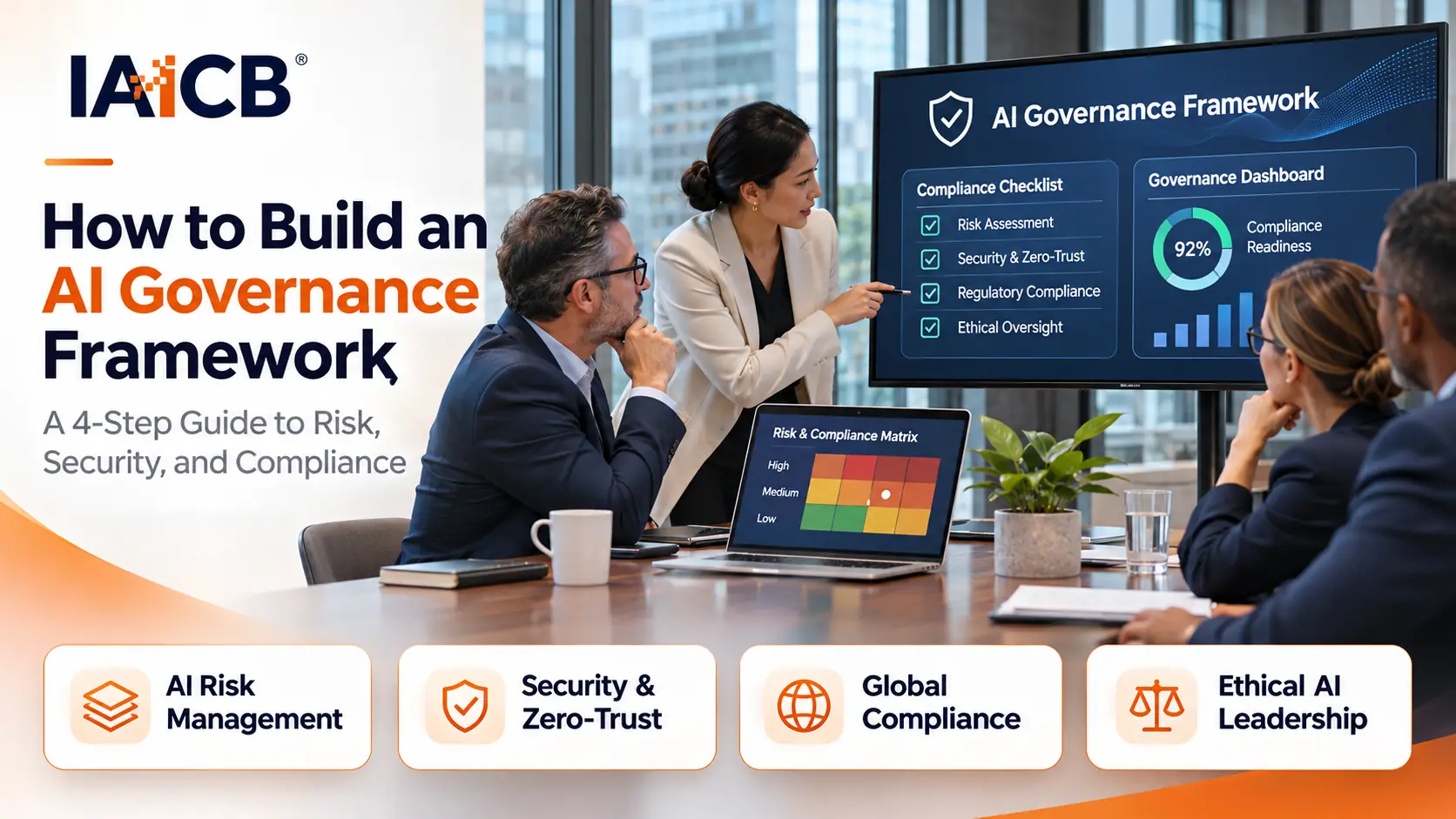
For CEOs, business leaders, and compliance professionals, here is a practical four-step framework for building trustworthy and secure enterprise AI systems.
1. Identify Enterprise AI Risks and Define Risk Appetite
Every AI implementation introduces risks that organizations must understand before deploying systems at scale.
An effective enterprise AI risk management strategy begins by identifying potential threats and determining how much risk the organization is willing to accept.
Common AI risks include:
- Data privacy risks: Unauthorized exposure of sensitive information.
- Algorithmic bias: AI decisions that create unfair or discriminatory outcomes.
- Inaccurate outputs: Incorrect AI-generated information affecting business decisions.
- Operational risks: System failures, unreliable performance, or excessive automation.
- Compliance risks: Violations of applicable laws and industry regulations.
Organizations should assess AI applications based on their business impact, likelihood of failure, and potential consequences.
For example, an AI system supporting marketing content may require different safeguards from an AI application used in financial decision-making or employee recruitment.
Defining AI risk appetite allows business leaders to establish appropriate controls and prioritize high-risk applications.
2. Strengthen AI Security with Zero-Trust Principles
As AI systems process business information and interact with enterprise applications, cybersecurity becomes a critical governance priority.
A zero-trust AI security approach follows the principle of never automatically trusting users, devices, or applications.
Organizations should implement:
- Access controls: Restrict sensitive AI systems and data to authorized users.
- Data protection: Secure confidential information through encryption and appropriate data handling.
- Continuous monitoring: Detect unusual activity, security threats, and performance issues.
- AI system resilience: Prepare systems to handle failures, malicious inputs, and unexpected behavior.
- Incident response: Establish procedures for identifying and addressing AI-related security incidents.
For example, businesses deploying AI-powered customer service tools should ensure that these systems cannot access customer information beyond their authorized permissions.
Strong AI security best practices help organizations reduce vulnerabilities while supporting reliable enterprise AI adoption.
3. Understand Global AI Regulations and Compliance Frameworks
As AI adoption grows, organizations must navigate evolving regulatory requirements and international governance standards.
Three important frameworks include:
- EU AI Act: Establishes legally binding, risk-based requirements for AI systems within its scope.
- NIST AI RMF: Provides a voluntary framework for identifying, assessing, and managing AI risks.
- ISO/IEC 42001: Defines requirements for establishing and improving an AI management system.
The EU AI Act applies progressively. Many provisions became applicable on August 2, 2026, while requirements for certain high-risk AI systems are scheduled for December 2027 and August 2028.
The NIST AI Risk Management Framework helps organizations structure their risk management activities around four functions: Govern, Map, Measure, and Manage.
Meanwhile, ISO/IEC 42001 provides a management system approach to responsible AI development and use.
Organizations should select appropriate governance practices based on their industry, jurisdiction, AI applications, and legal obligations.
Together, these resources can help businesses develop a structured AI compliance and governance strategy.
4. Establish Responsible AI Leadership and Board-Level Oversight
AI governance is not solely the responsibility of technology departments. It requires active involvement from executive leadership and organizational decision-makers.
A successful responsible AI governance framework should include:
- Transparency: Clearly communicate how AI systems are used and explain important decisions where appropriate.
- Accountability: Assign responsibility for AI performance, risk management, and regulatory compliance.
- Fairness: Evaluate AI systems for potential bias and discriminatory outcomes.
- Human Oversight: Ensure appropriate human involvement in consequential AI decisions.
- Board-Level Governance: Provide senior leadership with regular reporting on AI risks, compliance, and organizational impact.
For example, an organization using AI in recruitment should establish procedures to evaluate fairness, review system performance, and maintain appropriate human decision-making authority.
Strong AI leadership and governance helps organizations balance innovation with accountability and responsible business practices.
Why AI Governance Matters for Business Leaders
Without effective governance, AI adoption can expose organizations to financial, operational, legal, and reputational risks.
A well-designed AI governance framework enables businesses to manage these challenges while supporting innovation and long-term growth.
Business leaders who understand AI risk assessment, cybersecurity, regulatory compliance, and ethical AI principles are better equipped to make informed technology decisions.
Frequently Asked Questions
What is an AI governance framework?
An AI governance framework is a structured set of policies, responsibilities, and controls that guide the responsible development, deployment, and management of AI systems.
What is the difference between NIST AI RMF and ISO/IEC 42001?
NIST AI RMF provides voluntary guidance for managing AI risks, while ISO/IEC 42001 establishes requirements for an organizational AI management system.
Why is AI risk management important?
AI risk management helps businesses identify security threats, protect sensitive information, reduce potential harm, and maintain accountability when deploying AI solutions.
Conclusion: Build Trustworthy AI Through Strong Governance
As artificial intelligence becomes central to business operations, responsible governance is essential for sustainable AI adoption.
By identifying AI risks, strengthening cybersecurity, understanding regulatory requirements, and establishing leadership accountability, organizations can build AI systems that are more secure, transparent, and trustworthy.
Successful AI transformation is not just about adopting advanced technology. It is about ensuring that innovation remains responsible, secure, and aligned with business objectives.
Develop the Skills to Lead Responsible AI Transformation
Effective AI leadership requires an understanding of strategy, risk management, governance, and responsible implementation.
Explore the Certified AI Strategy Leader (CAISL™) certification offered by the International AI Certification Board (IAICB).
Build your understanding of enterprise AI strategy, regulatory awareness, responsible AI governance, and organizational transformation.
References
Key takeaways
- Identify enterprise AI risks and define risk appetite before scaling high-impact systems.
- Apply zero-trust AI security: access controls, encryption, monitoring, resilience, and incident response.
- Map obligations to the EU AI Act, NIST AI RMF, and ISO/IEC 42001 based on jurisdiction and use cases.
- Assign board-level oversight with transparency, accountability, fairness, and human review of consequential decisions.
- Treat governance as how organizations adopt AI responsibly — not as a blocker to innovation.