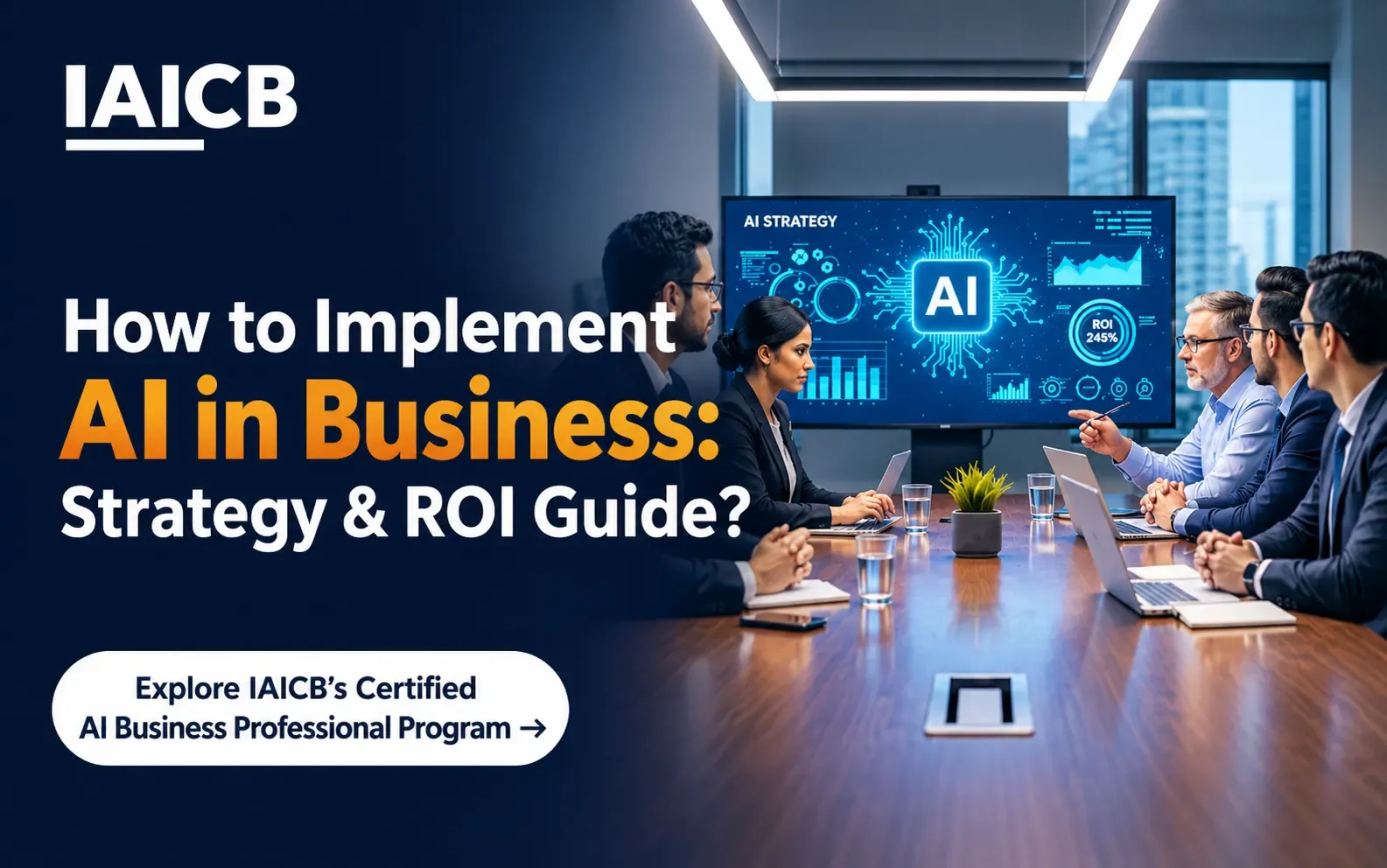
Artificial Intelligence is no longer just a technology trend. It is becoming an essential part of how modern businesses operate, compete and grow. From automating repetitive tasks to improving customer experiences and supporting strategic decisions, AI is transforming organizations across industries.
However, adopting AI successfully requires more than simply purchasing new tools. Businesses need a clear AI implementation strategy, the right talent, effective governance and measurable objectives.
So, how can organizations implement AI effectively? Let's explore.
1. Why Businesses Need an AI Implementation Strategy
Many organizations are experimenting with AI, but not all have a structured plan for integrating it into their operations.
A well-defined AI strategy helps businesses:
- Improve operational efficiency and productivity.
- Reduce repetitive manual work through automation.
- Make faster, data-driven business decisions.
- Improve customer service and personalization.
- Identify new revenue opportunities.
- Strengthen their competitive advantage.
Without a clear strategy, businesses risk investing in AI solutions that deliver little measurable value.
2. Identify the Right AI Opportunities
The first step towards successful AI adoption is identifying where AI can create genuine business value.
Organizations should evaluate their existing processes and identify areas where AI can solve problems or improve performance.
Some practical examples include:
- Marketing: AI-powered customer segmentation, content analysis and campaign optimization.
- Human Resources: Recruitment assistance, workforce analytics and employee engagement.
- Finance: Financial forecasting, fraud detection and reporting automation.
- Customer Service: AI chatbots, virtual assistants and automated customer support.
- Operations: Predictive maintenance, inventory optimization and workflow automation.
The goal is not to implement AI everywhere. It is to implement it where it delivers the greatest business impact.
3. Assess Business Readiness for AI Adoption
Before investing in AI, businesses must understand whether they are ready to adopt it.
This involves evaluating:
- Data quality and availability.
- Existing technology infrastructure.
- Employee AI awareness and skills.
- Organizational readiness for change.
- Data privacy and security requirements.
Employee training is particularly important. Even the most advanced AI solutions cannot deliver their full potential if teams do not understand how to use them effectively.
4. Measure AI ROI and Business Impact
AI investments should be evaluated using measurable business outcomes rather than technological excitement.
Businesses can measure AI performance through:
- Reduction in operational costs.
- Time saved through automation.
- Improvement in employee productivity.
- Customer satisfaction and retention.
- Revenue growth and conversion rates.
- Reduction in operational errors.
Start with a small pilot project, establish a baseline, measure the results and expand successful initiatives across the organization.
This approach helps businesses make informed investment decisions and demonstrate the actual value of AI.
5. Establish AI Governance and Risk Management
Responsible AI adoption is essential for long-term business success.
Organizations must address potential risks, including data privacy violations, biased AI outputs, cybersecurity threats and inaccurate information.
An effective AI governance framework should establish:
- Clear policies for AI usage.
- Data protection and privacy standards.
- Human oversight of critical AI decisions.
- Transparency and accountability.
- Regular monitoring and evaluation of AI systems.
Businesses that prioritize responsible AI practices are better positioned to build trust with customers, employees and stakeholders.
6. Develop the Skills to Lead AI Transformation
Technology alone does not transform businesses. People with the right knowledge and leadership capabilities make that transformation possible.
Modern business professionals need to understand how AI works, identify business opportunities, evaluate AI investments, manage AI-driven projects and implement responsible AI practices.
This is where professional AI education and certification can make a difference.
The Certified AI Business Professional (CAIBP) certification from the International AI Certification Board (IAICB) is designed to help professionals develop the business knowledge and strategic capabilities required to navigate AI adoption and organizational transformation.
Explore the Certified AI Business Professional certification to learn more.
Conclusion
Implementing AI in business is not simply about adopting new technology. It is about creating a structured approach to innovation, improving business performance and preparing organizations for the future.
Businesses that combine the right AI strategy, skilled professionals, responsible governance and measurable objectives will be better equipped to succeed in an increasingly AI-driven economy.
The future belongs to businesses that know how to use AI strategically. The question is: are you ready to lead that transformation?
Key takeaways
- A clear AI implementation strategy prevents tool sprawl and focuses investment on measurable value.
- Prioritize AI opportunities by business impact — marketing, HR, finance, customer service and operations.
- Assess readiness across data, infrastructure, skills, change readiness and privacy before scaling.
- Measure ROI with cost, productivity, customer and revenue metrics; pilot, then expand what works.
- Pair governance and skilled professionals — such as CAIBP-trained leaders — with technology adoption.