A business launches an AI customer-service assistant. It answers everyday questions—but then gives a customer incorrect refund advice.
Who notices? Who can correct it? And who is accountable for the outcome?
These are governance questions, not just technical ones.
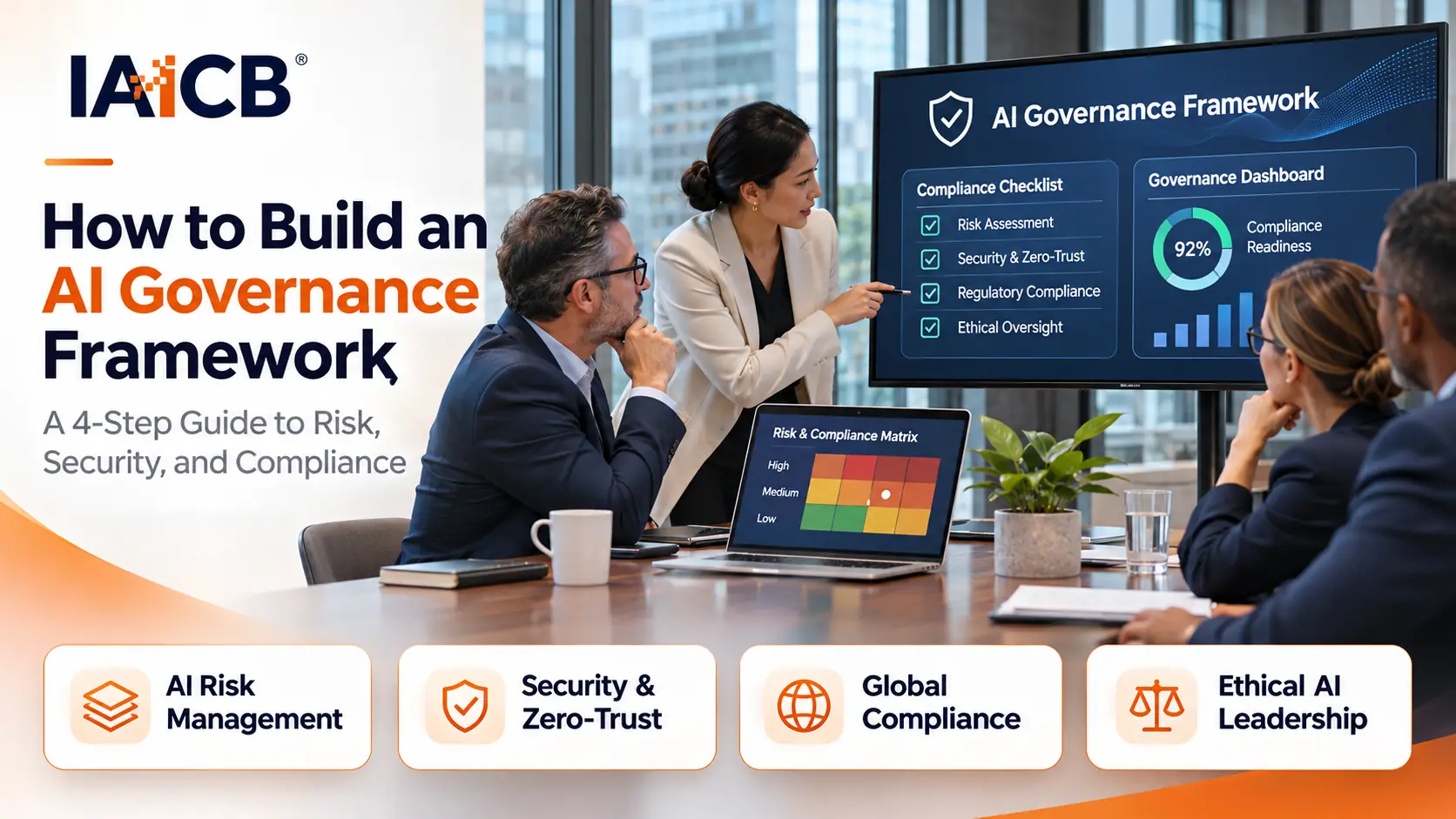
An AI governance framework turns risk awareness into repeatable decisions about how AI can be approved, used, and improved responsibly.
Why AI Governance Must Go Beyond Risk Management
Risk management asks what could go wrong. Responsible AI adoption also asks who decides, what evidence is required, and what happens after the system launches.
Without those answers, even a well-written policy may be ignored in everyday workflows.
Governance works best when embedded into procurement, system design, employee training, approval processes, and performance monitoring.
A Practical Five-Part AI Governance Framework
1. Inventory AI Systems
Maintain a register of the AI tools used across your organization.
Record their business purpose, providers, data requirements, affected stakeholders, and accountable owners.
2. Assess Risks and Potential Impacts
Evaluate potential concerns involving accuracy, privacy, cybersecurity, fairness, reliability, and consequences for affected individuals.
Not every AI application requires the same level of scrutiny. A routine writing assistant and a system influencing employment decisions present different risks.
3. Establish Responsible AI Controls
Introduce safeguards appropriate to the use case.
These may include human oversight, data-access restrictions, quality testing, employee training, and procedures for handling incorrect outputs.
4. Document Decisions and Accountability
Before deployment, record the results of testing, unresolved limitations, responsible approvers, and conditions for acceptable use.
Clear ownership helps organizations make informed decisions about when AI is ready for deployment.
5. Monitor, Review, and Improve
AI governance should continue after implementation.
Monitor errors, complaints, changing performance, and emerging risks. Reassess systems when significant changes or incidents occur.
Example: Responsible AI in Customer Service
Consider a retailer introducing an AI assistant to respond to refund requests.
The assistant could improve response times, but incorrect information might create disputes or financial losses.
A responsible governance approach would establish:
- A named business owner.
- Validation against current refund policies.
- Human review for exceptional or disputed cases.
- Monitoring of errors and customer complaints.
The objective is not to prevent AI automation. It is to make automation more accountable and dependable.
Understanding AI Governance Standards
The NIST AI Risk Management Framework is a voluntary framework organized around four functions: Govern, Map, Measure, and Manage.
ISO/IEC 42001 establishes requirements for an organizational AI management system.
Organizations operating in relevant jurisdictions must also consider applicable regulations, including the EU AI Act.
These frameworks and regulations serve different purposes. Adopting a voluntary framework or management standard does not automatically establish legal compliance.
Your First 30 Days of AI Governance
- Week 1: Identify AI applications and assign accountable owners.
- Week 2: Assess potential risks and prioritize important use cases.
- Week 3: Define approval requirements, human oversight, and escalation procedures.
- Week 4: Test governance controls in one workflow and begin monitoring outcomes.
Start with one meaningful application rather than attempting to govern every AI system simultaneously.
From Risk Management to Responsible Adoption
Effective AI governance is not simply a collection of rules.
It is an operational capability that connects technology, leadership, employees, and business objectives.
Organizations that establish clear accountability, proportional safeguards, and continuous monitoring can make more informed decisions about adopting and scaling AI.
Responsible AI adoption begins when governance becomes part of everyday business decisions.
Professionals seeking to develop their capabilities in AI strategy, governance, and responsible implementation can explore IAICB's Certified AI Strategy Leader and Certified AI Business Professional programs.
Key takeaways
- Start with an AI inventory and assign accountable business owners.
- Apply safeguards according to the potential impact of each AI application.
- Monitor AI after deployment and establish clear escalation procedures.