If you want to know how to become an AI engineer in 2027, the short answer is to build real systems, learn the tools that take a model from a notebook into production, and prove your skills with hands-on projects and a credible certification. The field now rewards builders over spectators.
Artificial intelligence has moved from research labs into the core of how software is made. Companies no longer want only people who can train a model — they want engineers who can design, ship, secure and maintain AI features that real users depend on. That shift has created one of the most in-demand roles in technology, and this guide maps the path into it.
What an AI Engineer Actually Does
An AI engineer builds software that uses artificial intelligence to solve a real problem — a recommendation feature, a document-search assistant, a fraud-detection service, a customer-support agent. The role sits where software engineering meets applied machine learning. Where a research scientist asks “can this model work at all?”, an AI engineer asks “how do we make this model reliable, fast, affordable and safe for thousands of users?”
In a typical week, an AI engineer might:
- Translate the need — turn a business goal such as “reduce support tickets” into a technical design.
- Choose an approach — decide whether to train a model, fine-tune an open one, or call a hosted large language model through an API.
- Build the plumbing — create the data pipelines that feed a model and the serving layer that exposes it.
- Make it production-ready — add retrieval, caching, guardrails and monitoring so the system behaves outside the lab.
- Measure and iterate — track quality, cost and latency, then improve.
It helps to separate three overlapping roles. A data scientist focuses on analysis, experimentation and insight. A machine learning engineer focuses on training, optimizing and deploying models at scale. An AI engineer — sometimes called an AI developer — focuses on building complete applications on top of models, increasingly on top of generative AI and LLMs. In practice these titles blur, and smaller teams often expect one person to do all three.
Why AI Engineering Skills Are in Demand
Demand for people who can build AI systems is broad and well documented. The World Economic Forum’s Future of Jobs Report 2025, based on a survey of more than 1,000 employers, ranks AI and machine learning specialists as the fastest-growing job category in percentage terms through 2030, and reports that 86% of surveyed employers expect AI and information-processing technologies to transform their business by the end of the decade.
Employers are no longer hiring people to experiment with AI — they are hiring people to ship it.
Government labour data points the same way. The U.S. Bureau of Labor Statistics projects employment of computer and information research scientists — the federal category closest to AI engineering — to grow 22% from 2025 to 2035, much faster than the average for all occupations.
The underlying market is expanding quickly too. Grand View Research valued the global machine learning market at roughly USD 55.8 billion in 2024 and projects it to reach about USD 282 billion by 2030, a compound annual growth rate above 30%.
Two themes matter for anyone entering the field. First, demand is concentrating in people who can take models into production, not just prototype them. Second, employers increasingly screen for demonstrated skills and portfolios over credentials alone — which is exactly why hands-on projects and practical certifications have become so valuable.
Essential Skills Required to Become an AI Engineer
Becoming an AI engineer means combining solid software fundamentals with applied machine learning and the newer generative-AI stack. The AI engineering skills below are the ones that appear most consistently in current job descriptions.
- Programming and software engineering — write clean, testable code, use version control (Git), work comfortably on the command line and in Linux, and understand APIs, containers and basic cloud services. AI features are software first.
- Mathematics and statistics — you do not need a PhD, but you do need working intuition for linear algebra, probability, statistics and a little calculus — enough to understand how models learn, why they fail, and how to evaluate them honestly.
- Data skills — most of the real work is data. You should be able to collect, clean, transform and explore data with libraries such as Pandas and NumPy, and visualize it to catch problems before they reach a model.
- Machine learning and deep learning — understand the main families of algorithms (regression, classification, clustering), how to train and evaluate models properly, and how neural networks work — including the modern transformer architecture.
- Generative AI and LLM skills — the fastest-growing area: prompt engineering, working with LLM APIs, retrieval-augmented generation (RAG), fine-tuning open models, and building AI agents.
- MLOps and deployment — knowing how to package, serve, monitor and update a model in production — with tools like Docker, FastAPI and a cloud platform — is what separates a demo from a product.
- Responsible AI and security — increasingly expected: guardrails against prompt injection and data leakage, bias and safety evaluation, and a working grasp of privacy and governance.
Programming Languages Every AI Engineer Should Know
Python — the default language of AI
If you learn one language, make it Python. Python for AI development is effectively the industry standard, thanks to its readable syntax and an unmatched ecosystem: NumPy and Pandas for data, scikit-learn for classical machine learning, PyTorch and TensorFlow for deep learning, and LangChain, LlamaIndex and the major LLM SDKs for generative AI. Almost every model, tutorial and research paper ships with Python code.
SQL — for working with data
AI runs on data, and most of that data lives in databases. Efficient SQL is a quiet but essential skill for pulling and shaping the data you train and evaluate on.
JavaScript / TypeScript — for shipping AI into products
Because so many AI features live inside web apps, knowing JavaScript or TypeScript — and a framework such as React or Node — helps you integrate models into real, user-facing products and build on top of LLM APIs.
Others, depending on your path
Rust, C++ and Go show up in performance-critical and systems work such as fast inference and infrastructure. Java and Scala appear in large enterprise data platforms. These are useful specializations, not starting points.
Start deep with Python, add SQL early, and pick up a web language when you begin deploying your work.
Machine Learning vs Deep Learning vs Generative AI
These three terms are often used interchangeably, but they describe nested ideas.
Machine learning (ML) is the broad field of algorithms that learn patterns from data instead of being explicitly programmed. A spam filter that learns from examples, or a model that predicts house prices from past sales, is machine learning. Classic techniques include linear and logistic regression, decision trees, random forests and clustering.
Deep learning is a subset of machine learning that uses neural networks with many layers. It excels at messy, high-dimensional data — images, audio and text — where hand-written rules break down. Deep learning powers image recognition, speech-to-text, and the transformer architecture behind today’s language models.
Generative AI is a further step: deep-learning models that create new content — text, code, images, audio — rather than only classifying or predicting. Large language models (LLMs) such as the GPT, Claude and Llama families are the best-known examples.
A simple way to hold it together: all deep learning is machine learning, and most generative AI is built on deep learning, but not all machine learning is deep, and not all AI work is generative. A strong AI engineer is comfortable across all three and chooses the simplest approach that solves the problem — often a classic ML model is cheaper and more accurate than an LLM.
Large Language Models (LLMs), RAG and AI Agents
Most AI engineering work in 2027 revolves around three connected ideas.
Large language models (LLMs)
An LLM is a deep-learning model trained on vast amounts of text to predict and generate language. You can use one through a hosted API (fast to start, no infrastructure to manage) or run an open model yourself (more control and privacy). Core skills here include prompt engineering — writing clear instructions and examples — and understanding limits such as context windows, latency, cost and hallucination.
Retrieval-augmented generation (RAG)
An LLM only “knows” what it was trained on, and it can invent facts. RAG fixes this by retrieving relevant information from your own documents at query time and giving it to the model as context. A RAG system typically splits documents into chunks, converts them into embeddings, stores them in a vector database (such as FAISS, Chroma or Pinecone), and retrieves the best matches for each question. This is how most enterprise “chat with your data” assistants are built.
AI agents
An agent is an LLM given a goal plus tools — search, code execution, APIs, databases — and the ability to plan, act and react in a loop. Instead of answering a single prompt, an agent can break a task into steps and carry them out. Frameworks such as LangGraph, CrewAI and AutoGen, and emerging standards like the Model Context Protocol (MCP) for connecting tools, are making agentic systems a core part of the AI engineer’s toolkit.
Building and Deploying Production-Ready AI Applications
A model in a notebook is not a product. Turning it into something users can rely on — the heart of AI engineering — involves a repeatable set of steps often grouped under MLOps (machine-learning operations).
- Wrap the model in an API. Expose your model or LLM workflow through a service, commonly built with FastAPI, so other applications can call it.
- Containerize and deploy. Package the service with Docker and run it on a cloud platform such as AWS, Azure or Google Cloud, scaling with Kubernetes when needed.
- Add retrieval and memory. Connect vector databases and live data sources so the system can use current, relevant information.
- Put in guardrails. Validate inputs and outputs, defend against prompt injection, filter unsafe content and prevent data leakage.
- Optimize cost and latency. Caching, batching and model quantization keep responses fast and affordable at scale.
- Monitor and iterate. Track quality, cost, latency and failures in production, and use CI/CD to ship improvements safely.
The engineers most in demand are the ones who can own this full lifecycle — not just build a model, but keep it reliable, secure and economical once real users depend on it.
Step-by-Step Roadmap to Becoming an AI Engineer in 2027
Here is a practical AI engineer roadmap for 2027. Treat it as a sequence of milestones rather than a fixed timeline — how fast you move depends on your starting point.
- Build programming foundations (1–3 months). Get fluent in Python, Git, the command line and basic Linux.
- Learn data and maths fundamentals (1–2 months). Pandas and NumPy for data; statistics, probability and linear algebra for reasoning about models.
- Study core machine learning (2–3 months). Train and evaluate classic models with scikit-learn, and build two or three small projects end to end.
- Move into deep learning (2–3 months). Learn neural networks with PyTorch or TensorFlow, including CNNs for images and transformers for text.
- Specialize in generative AI (2–3 months). Work with LLM APIs, prompt engineering, RAG and your first AI agent.
- Learn deployment and MLOps (1–2 months). Containerize a project, serve it through an API, deploy to the cloud and add monitoring.
- Build a portfolio and ship a capstone. Put three to five projects on GitHub, including one production-grade application that shows the full lifecycle.
- Validate your skills with a certification. A structured, hands-on credential can confirm your competencies and fill gaps in your self-study.
Throughout, favor building over passive watching. Employers consistently hire for what you can demonstrate, not how many courses you have started.
AI Engineer Career Opportunities and Salary Considerations
AI engineering is not a single job but a career path with several branches. Common roles include AI/ML engineer, LLM or generative-AI engineer, NLP engineer, computer-vision engineer, MLOps engineer and applied AI engineer. Many people enter from software development or data science and specialize over time.
What AI engineers earn
Salaries vary widely by country, city, experience and specialization, so treat any single number with caution. In the United States, 2026 compensation trackers put the average base salary for an AI engineer roughly in the $150,000–$185,000 range — for example, Indeed reported an average base of about $152,000, while Salary.com reported about $184,000. Entry-level roles typically start lower, often around $100,000–$130,000, while senior and specialist engineers — particularly in generative AI — can earn well above $200,000 in total compensation, with the highest-paying firms going considerably higher.
For a more conservative public benchmark, the U.S. Bureau of Labor Statistics reports a 2025 median wage of $140,300 for computer and information research scientists, the closest official category.
Outside the U.S., salaries are generally lower in absolute terms but often strong relative to local markets, and remote roles have widened access to higher pay. Because figures differ so much between sources and regions, use these as directional context and research live data for your own market before making career decisions.
Why the opportunity is durable
The roles growing fastest are those that pair AI with the ability to ship and maintain real systems. As AI spreads beyond tech companies into healthcare, finance, manufacturing and the public sector, demand is broadening rather than narrowing — which makes practical, deployment-focused skills a strong long-term bet.
Choosing the Right AI Developer Certification
A good certification does two things: it gives you a structured path through a large, fast-moving field, and it signals verified skills to employers. A weak one is just a quiz. When comparing an AI developer certification, look for:
- Hands-on, project-based learning. The best programs make you build and deploy real systems, with a capstone and a portfolio you can show.
- A current, production-focused curriculum. It should cover today’s stack — Python, machine learning, deep learning, LLMs, RAG, agents and MLOps — not theory from a few years ago.
- Credible assessment. A proctored or rigorously evaluated exam makes the credential mean something.
- Vendor-neutral coverage. Cloud-specific certificates are valuable, but a vendor-neutral AI engineer certification teaches transferable principles you can apply anywhere.
- Governance and recognition. Check who issues and maintains the credential and whether it is recognized in your target market.
- The right level. Some AI certification for software developers assumes you can already code; absolute beginners may need a foundational course first.
Certifications complement a portfolio and real experience — they do not replace them. The strongest candidates pair demonstrated projects with a respected credential.
The IAICB Certified AI Developer (CAID™) Certification
If you want a structured way to build and prove the skills covered in this guide, the Certified AI Developer (CAID™) certification from the International AI Certification Board (IAICB) is designed around exactly this path. It is a vendor-neutral, exam-based credential for engineers and developers who want to build, fine-tune and deploy production-ready AI systems.
The program maps closely to the competencies employers ask for:
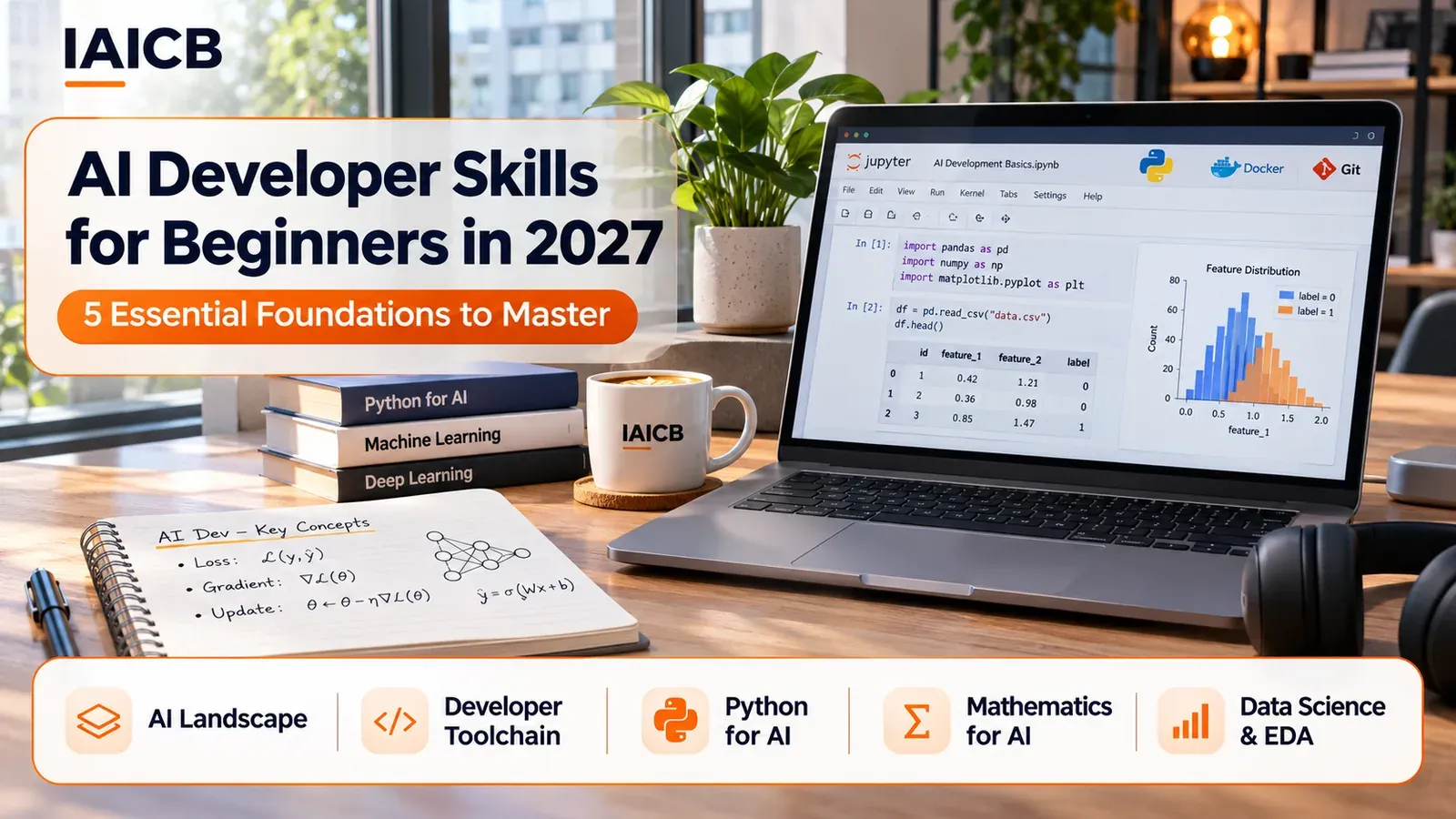
- Foundations — Python for AI, the developer toolchain (Git, Docker, Jupyter) and data analysis with Pandas, NumPy and Matplotlib.
- Core machine learning and neural networks — classical ML, model evaluation and deep learning with PyTorch and TensorFlow/Keras.
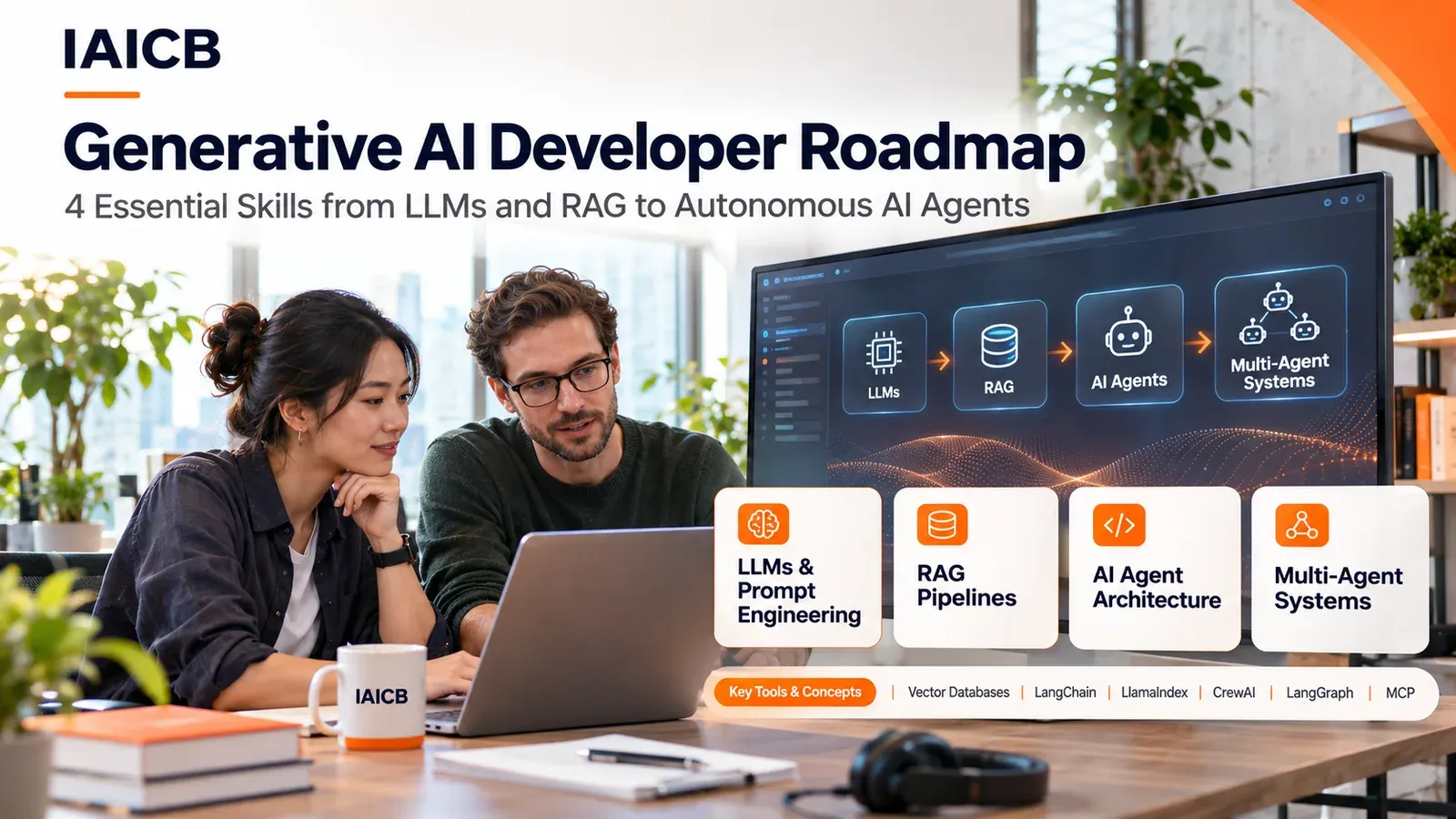
- Generative AI, RAG and autonomous agents — LLMs, prompt engineering, vector databases, LangChain and LlamaIndex, and multi-agent frameworks.
- Computer vision, MLOps and system design — deployment with FastAPI, Docker and Kubernetes, cloud platforms and scalable inference.
- An enterprise capstone and portfolio — an end-to-end production project and a GitHub portfolio you can show employers.
It is delivered fully online with self-paced modules and hands-on labs on virtual GPU clusters, and is assessed by a proctored exam. The curriculum assumes you are comfortable writing code — IAICB recommends roughly one to two years of programming experience or equivalent logic — so it suits software developers, data scientists moving into production, and computer-science graduates more than absolute beginners. Flexible study tiers are available; current details, pricing and any scholarships are on the CAID certification page.
Used alongside your own projects, a credential like this gives your self-study a clear structure and gives employers a verifiable signal of what you can do.
Frequently Asked Questions
How long does it take to become an AI engineer?
With consistent effort, most people coming from a programming background can become job-ready in roughly 9–15 months of focused study and project work. Complete beginners should budget longer to build software foundations first.
Do I need a degree to become an AI engineer?
A degree helps, especially in computer science, but it is not strictly required. Employers increasingly hire on demonstrated skills — a strong portfolio of deployed projects and a credible certification can matter more than a specific diploma.
Can I become an AI engineer without a machine learning background?
Yes. Many AI engineers come from software development and learn ML along the way. Because so much modern work is built on LLM APIs, RAG and agents, you can start building useful AI applications earlier than you might expect, then deepen your ML knowledge over time.
Is Python enough to become an AI engineer?
Python is the essential core, but not the whole picture. You will also want SQL for data, comfort with Git, Docker and a cloud platform for deployment, and ideally some JavaScript or TypeScript for shipping AI into products.
What is the difference between an AI engineer and a machine learning engineer?
The titles overlap. Machine learning engineers tend to focus on training and optimizing models at scale; AI engineers focus on building complete applications on top of models, increasingly using generative AI. On smaller teams, one person often does both.
Are AI certifications worth it?
A rigorous, hands-on certification is worth it when it gives you structure, fills gaps in your knowledge, and produces a portfolio and a credential employers trust. It works best as a complement to real projects, not a replacement for them.
Which skills are most in demand for AI engineers in 2027?
Python, applied machine learning and deep learning, and the generative-AI stack — LLMs, prompt engineering, RAG and agents — alongside MLOps and deployment skills and an understanding of AI safety and security.
How much do AI engineers earn?
It varies widely by region, experience and specialization. In the U.S., 2026 trackers place average base pay roughly in the $150,000–$185,000 range, with generative-AI specialists and senior engineers earning more; salaries elsewhere are typically lower in absolute terms but strong relative to local markets. Always check current data for your own location.
How do I start if I am a complete beginner?
Begin with Python and basic programming, then data handling, then core machine learning, before moving on to deep learning and generative AI. Build a small project at each stage, and consider a foundational course before attempting a developer-level certification.
Key takeaways
- AI engineering is a builder’s discipline — it is about shipping and maintaining AI features in production, not just training models.
- Python plus the generative-AI stack is the core skill set — add SQL, deployment and MLOps, and a solid grasp of LLMs, RAG and agents.
- Demand is strong and broadening across industries, and employers increasingly hire on demonstrated skills and portfolios.
- A roadmap beats random courses — progress from foundations through machine learning, deep learning, generative AI and deployment, shipping a capstone along the way.
- A credible, hands-on certification validates your skills and gives your self-study structure.